Leadership challenges in complex operational environments
Leadership Challenges in Complex Operational Environments
A governance-led, practical framework for judicial services and distributed multi-site operations
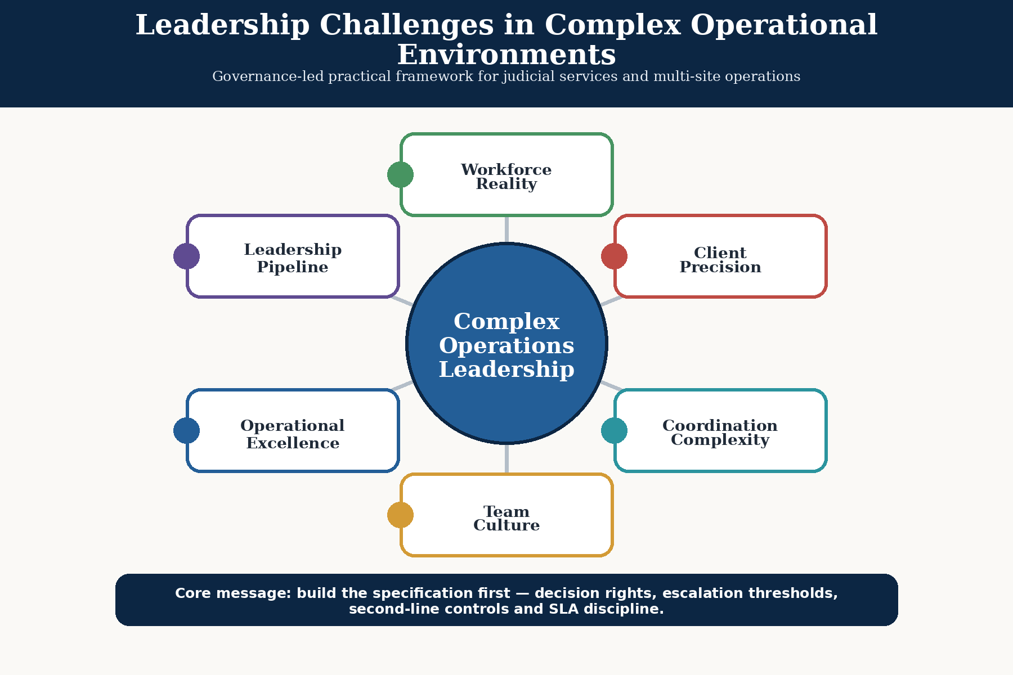
Executive Summary
Leadership in complex operational environments is not only a matter of personal capability. It is a matter of governance design. In distributed operations across India, where sites are dispersed, wages at the frontline are low, turnover is high and judicial service clients expect flawless delivery, performance variation is often wrongly attributed to the quality of people available.
That instinct is usually expensive. The same manager may perform differently under different structures. This means the variable is not always the manager; very often it is the operating structure around the manager. When decision rights, escalation thresholds, second-line controls and breach-linked retraining are unclear, managers respond rationally to weak incentives.
This article is written in the context of leadership challenges in complex operational environments and explains my experience working with judicial services, exacting client expectations, low-wage workforce, high attrition, multi-site coordination and pressure to deliver. It also aligns the operational resilience, SLA discipline, process governance, second-line leadership, audit-ready controls and structured leadership systems.
The Central Argument: Escalation Is a Designed Behaviour
A manager who escalates everything and a manager who escalates nothing are often responding to the same missing structure. One appears diligent but may actually lack decision rights. The other appears to own the issue but may actually fear being seen as weak for asking for help.
Neither situation is solved by generic leadership training. If there is no stated threshold for escalation, no protection for escalating early and no consequence for escalating late, the manager will return from training and behave exactly as before. Capability work that survives contact with operations must look like a specification, not just a course.
A governed operation specifies the SOP, turnaround clock and escalation matrix. It must also specify the behaviour of the people operating them. The second line is a control. In many operations it is the only control that nobody has deliberately designed.
Governance-Aligned Leadership Challenge Map
Understanding the Leadership Landscape
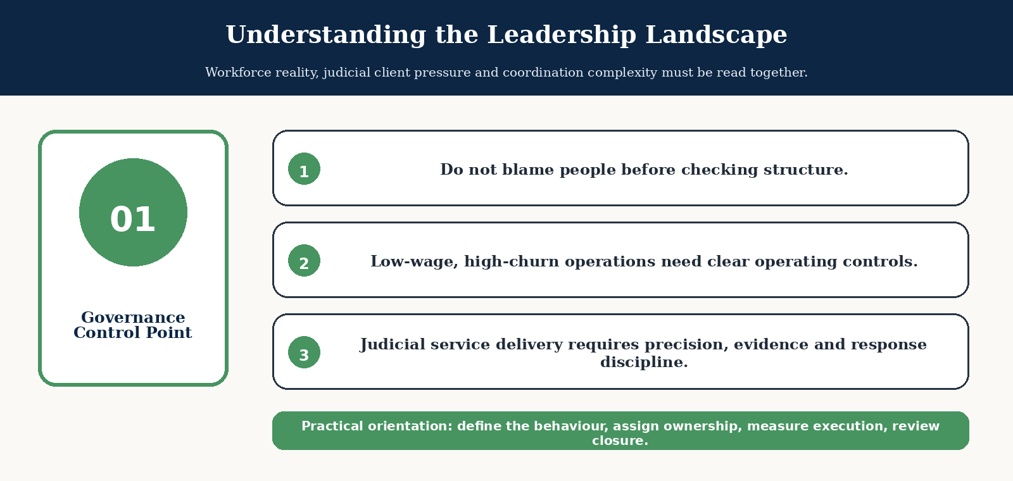
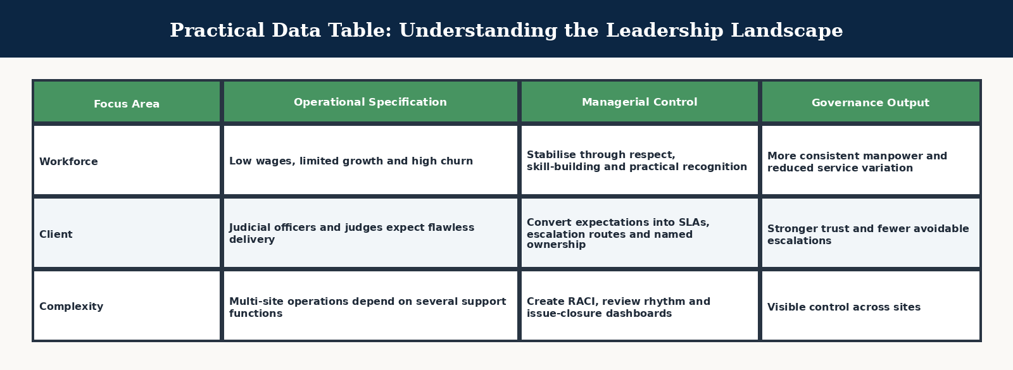
The governance lesson is that leaders should not begin by blaming manpower quality. They should first check whether the operating system has defined decision rights, escalation thresholds, review cadence and support ownership. Poor performance is often not a people problem alone; it is a system problem made visible through people.
A practical manager should therefore map the workforce condition, client expectation and site-level process gap before launching training or motivational interventions.
Practical Leadership Actions
· Do not blame people before checking structure.
· Low-wage, high-churn operations need clear operating controls.
· Judicial service delivery requires precision, evidence and response discipline.
.
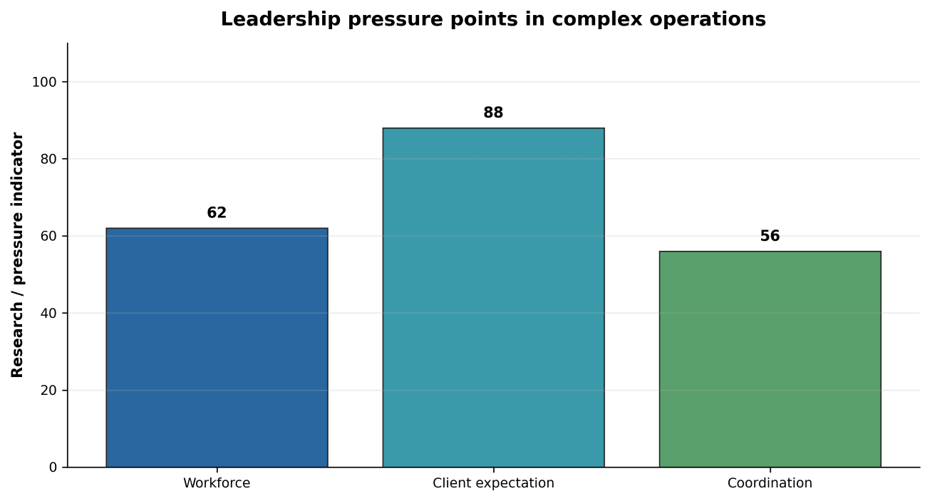
graph showing the pressure points
Escalation as a Designed Behaviour
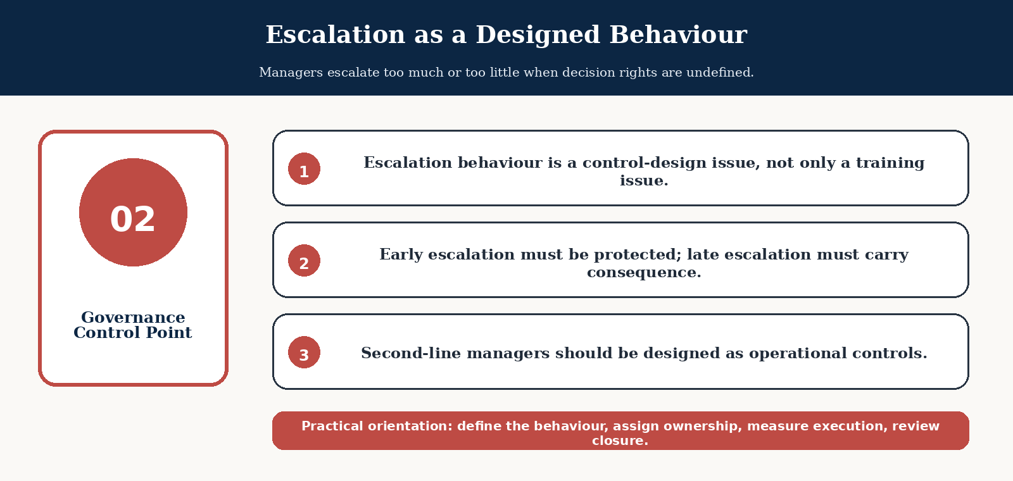
Escalation is not only a communication act. It is a designed behaviour. Where decision rights are unclear, some managers escalate everything because they do not know what they are authorized to decide. Others escalate nothing because they believe early escalation will be seen as weakness.
Both behaviours are rational responses to poor operating design. The corrective action is not generic leadership training. The corrective action is to specify what the role can decide alone, what must be escalated, within what time and to whom by name.
In a governance-led operation, early escalation should be protected, late escalation should be reviewed and repeated breach behaviour should trigger targeted retraining linked to the actual incident.
Practical Leadership Actions
· Escalation behaviour is a control-design issue, not only a training issue.
· Early escalation must be protected; late escalation must carry consequence.
· Second-line managers should be designed as operational controls.
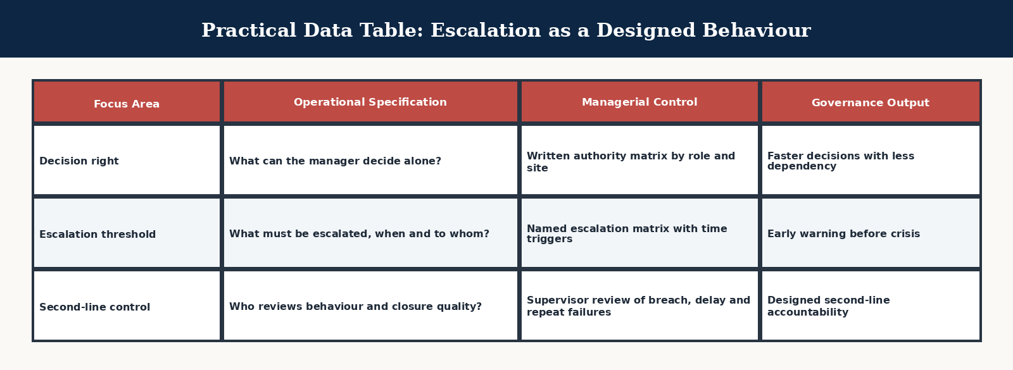
Data table
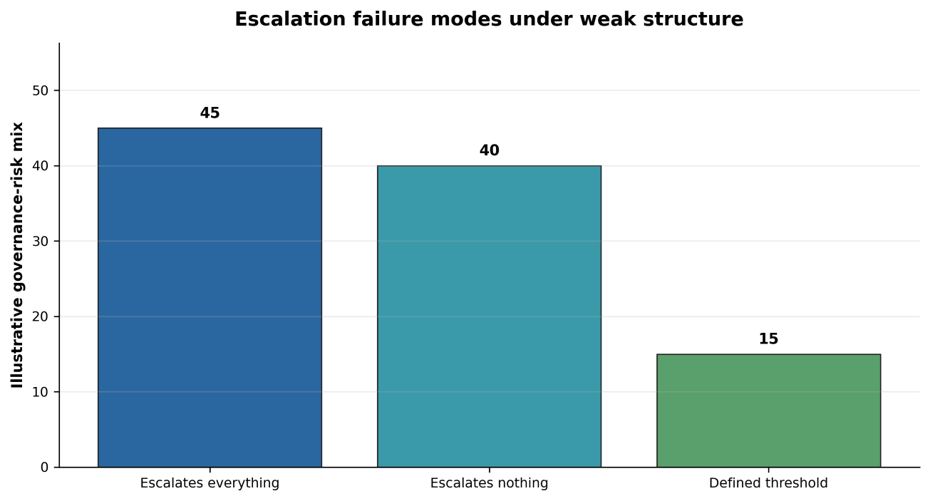
Escalation failure modes graph
Team Culture and Communication
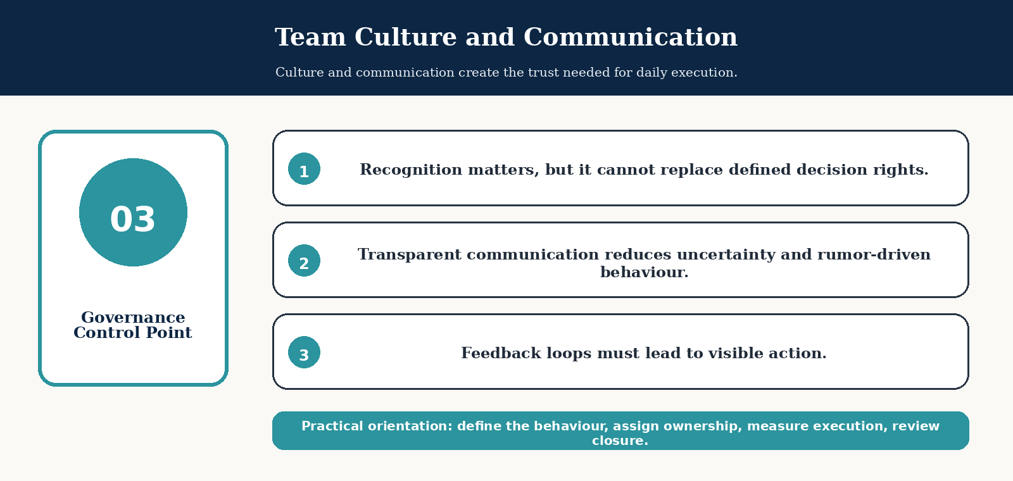
Team culture, recognition, development and transparent communication remain essential, especially in low-wage and high-churn environments. People need dignity, respect and clarity. These interventions improve morale and reduce avoidable friction.
However, culture cannot replace structure. Recognition does not define a decision right. Morale does not create an escalation threshold. Communication does not substitute for accountability. A practical leader must therefore combine human engagement with operational specification.
The strongest culture in complex operations is one where employees know what is expected, supervisors know what they can decide and managers know when intervention is required.
Practical Leadership Actions
· Recognition matters, but it cannot replace defined decision rights.
· Transparent communication reduces uncertainty and rumor-driven behaviour.
· Feedback loops must lead to visible action.
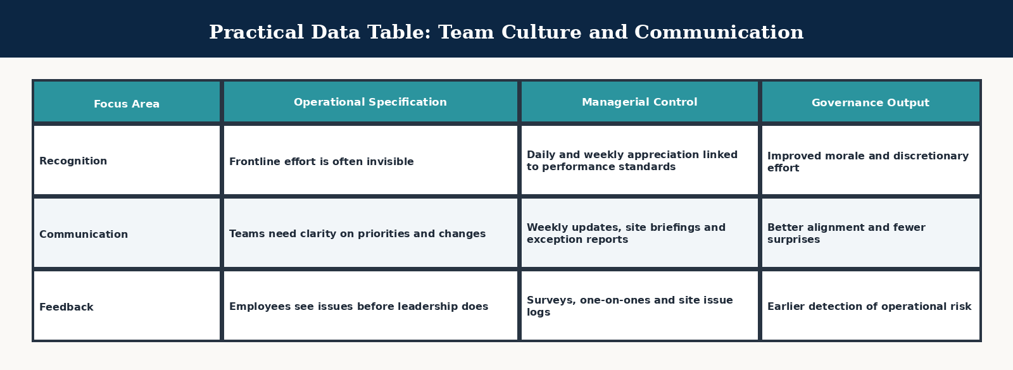
Data table
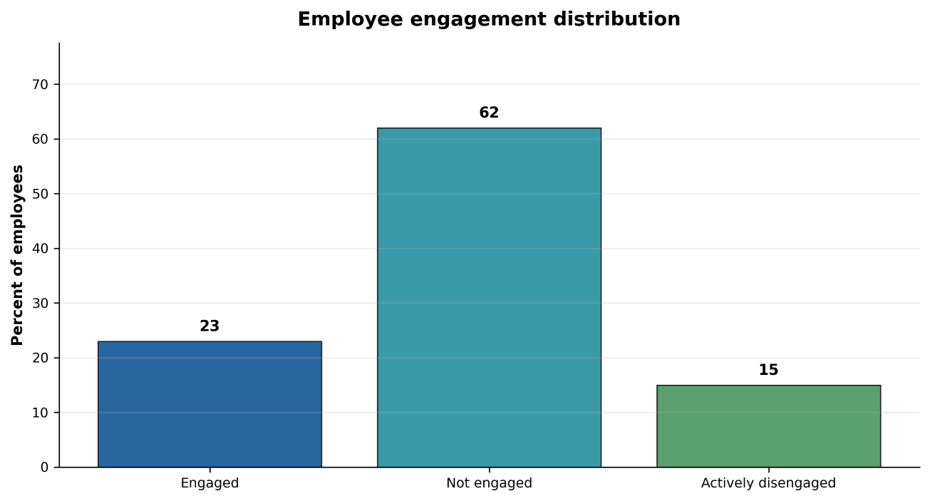
Employee Engagement
Operational Excellence and SLA Discipline
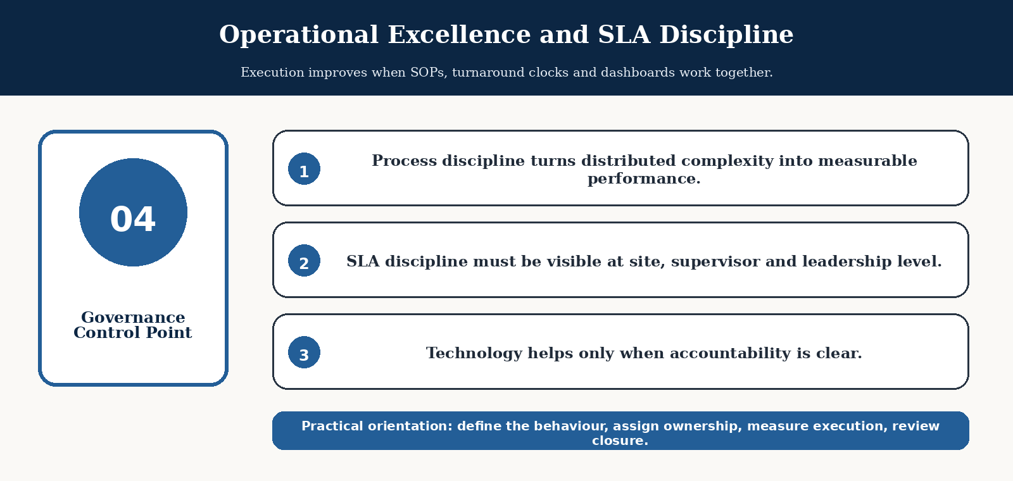
Operational excellence is the discipline that converts leadership intent into measurable delivery. SOPs, turnaround clocks, dashboards, escalation matrices and resource allocation plans should not sit separately. They must operate as one governance system.
For judicial services, this is critical because the client expects precision and timeliness. A delayed service, incomplete update or unclear handoff can quickly become a credibility issue.
The practical leadership task is to build a visible operating rhythm: daily exception reviews, weekly SLA trend reviews, site-level dashboards, breach analysis and corrective action closure.
Practical Leadership Actions
· Process discipline turns distributed complexity into measurable performance.
· SLA discipline must be visible at site, supervisor and leadership level.
· Technology helps only when accountability is clear.
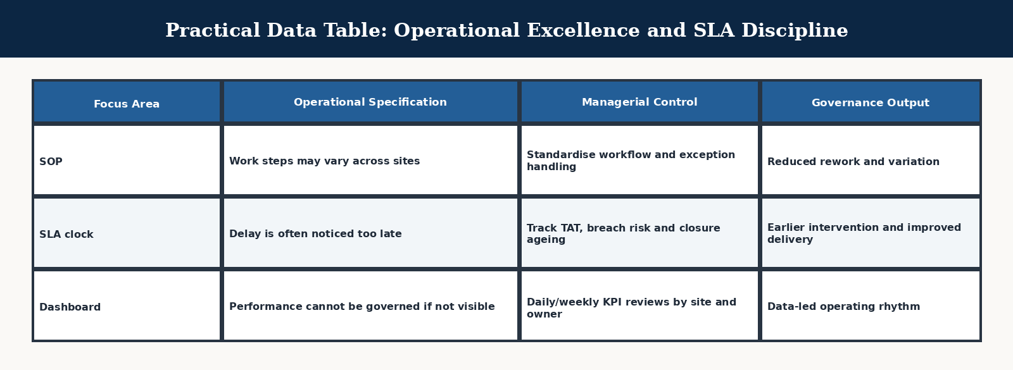
Data table
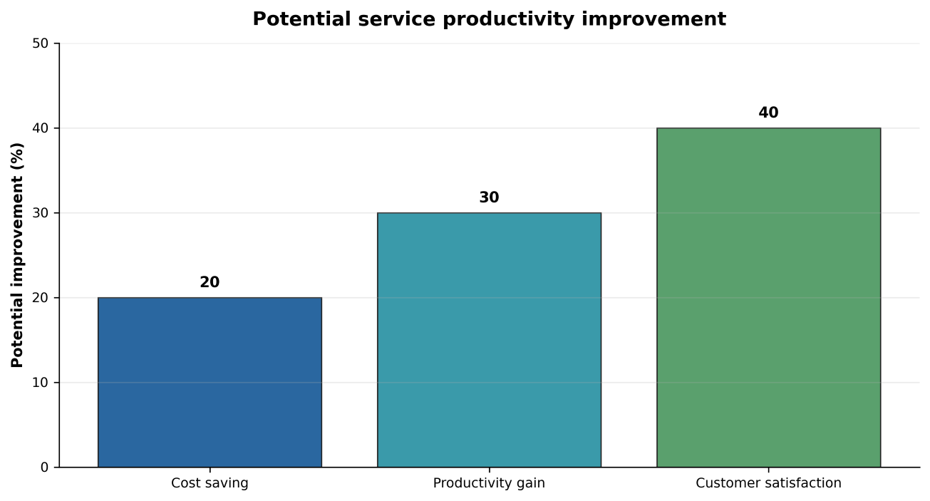
Service productivity graph
Employee Retention and Morale
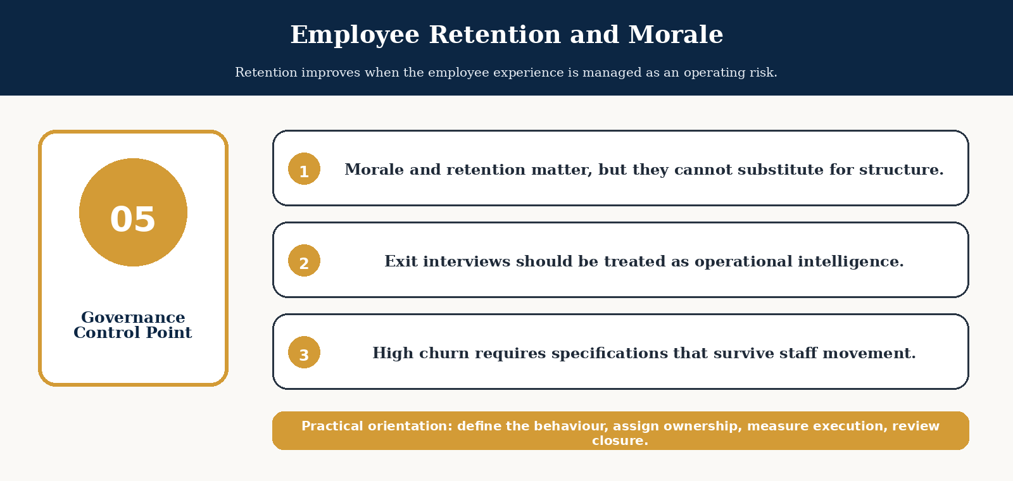
Retention and morale matter deeply. The usual remedies—recognition, development, better working environment and transparent communication—are worth doing on their own terms. But they do not substitute for defined decision rights, especially in a high-churn operation.
A high-churn environment needs specifications that survive people movement. Training leaves when people leave; role clarity, SOPs, escalation triggers and documented breach learning remain.
This is where governance and people leadership meet. Retention improves when employees feel respected, but operating resilience improves when the system does not collapse every time trained manpower exits.
Practical Leadership Actions
· Morale and retention matter, but they cannot substitute for structure.
· Exit interviews should be treated as operational intelligence.
· High churn requires specifications that survive staff movement.
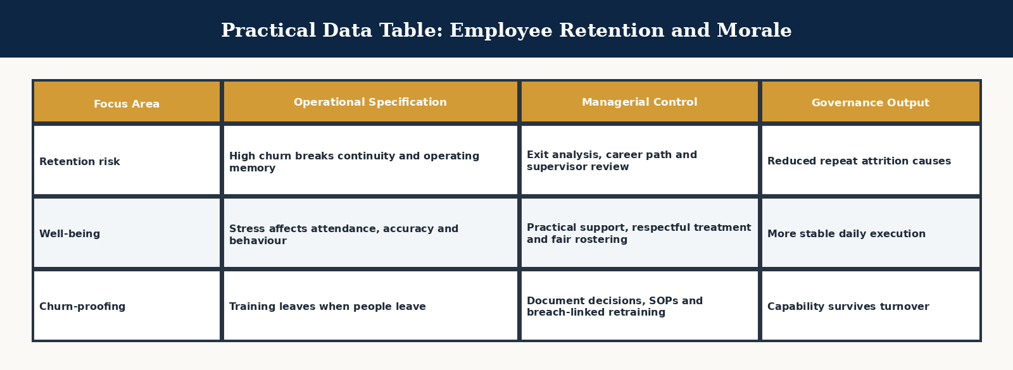
Data table
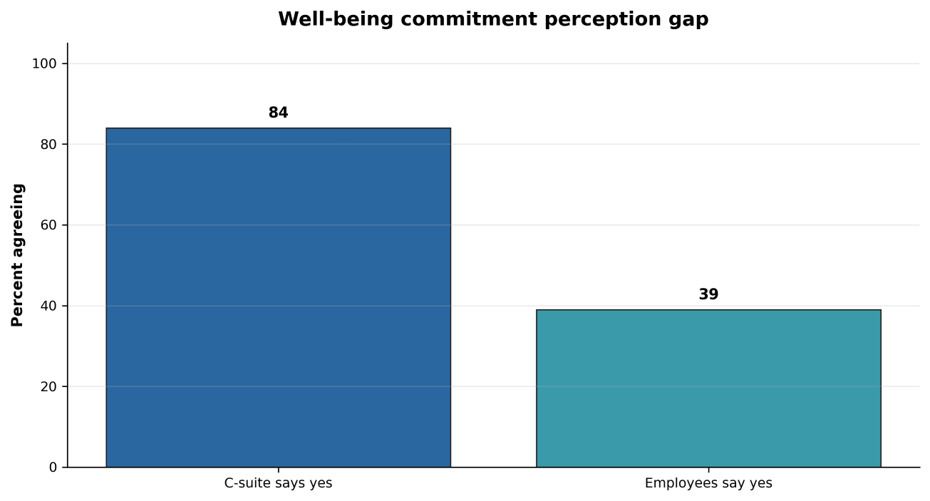
Wellbeing Commitment gap
Client Relationship Management
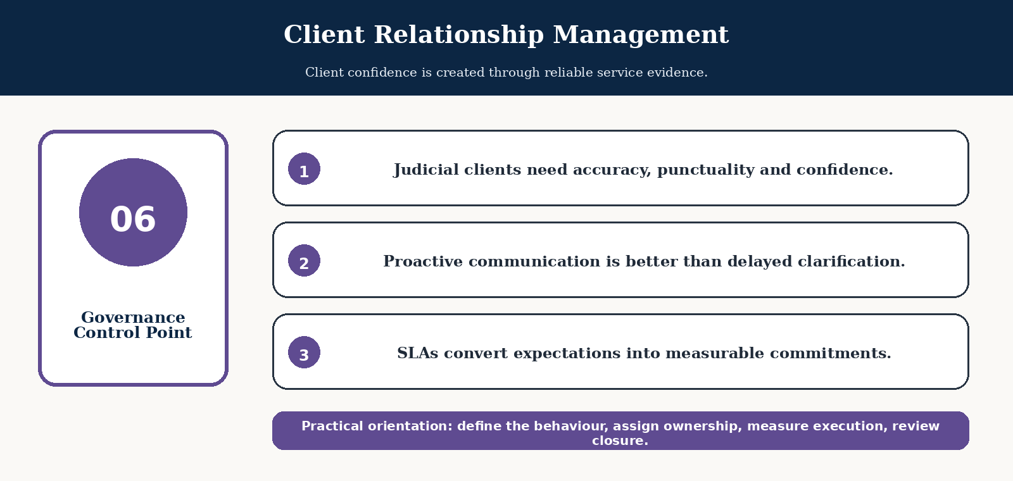
The client environment in the original article is demanding by design. Judicial officers and judges expect accurate, punctual and reliable service. They should not have to chase updates or decode operational ambiguity.
Client relationship management must therefore be structured through named ownership, feedback loops, proactive status updates and SLA governance. This protects client confidence and gives managers measurable evidence of performance.
In governance terms, client confidence is not created by words. It is created by reliable data, disciplined response, traceable closure and visible accountability.
Practical Leadership Actions
· Judicial clients need accuracy, punctuality and confidence.
· Proactive communication is better than delayed clarification.
· SLAs convert expectations into measurable commitments.
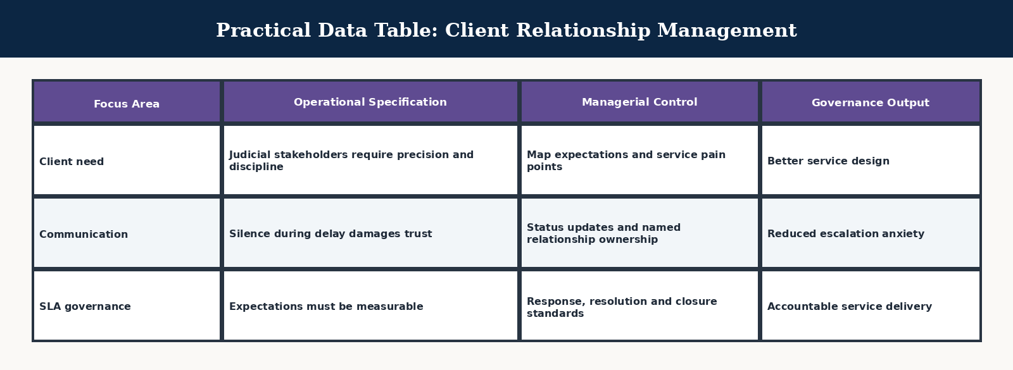
Data table
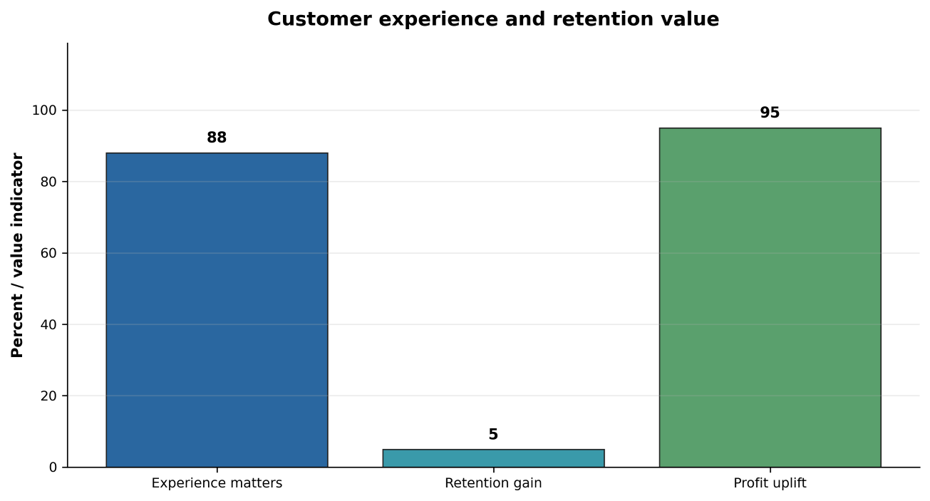
Customer retention value chart
Leadership Pipeline as Governance Control
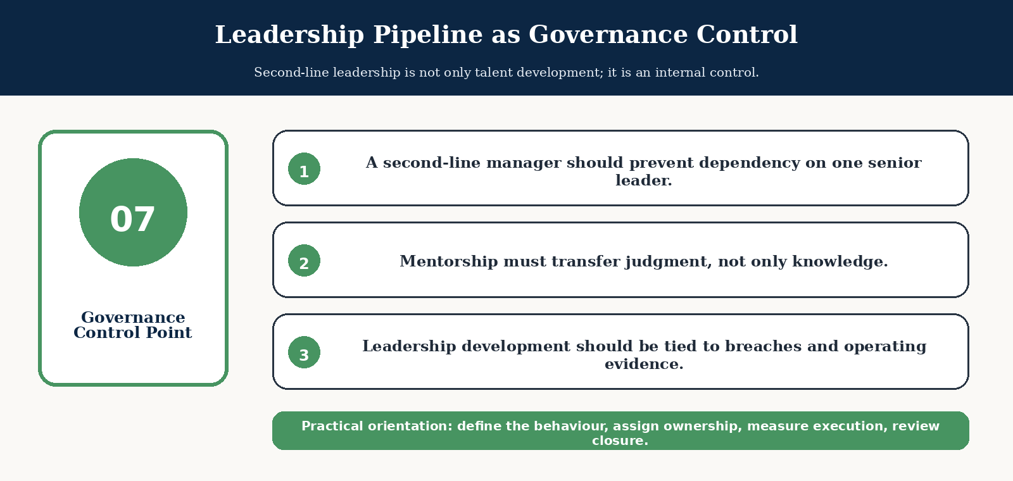
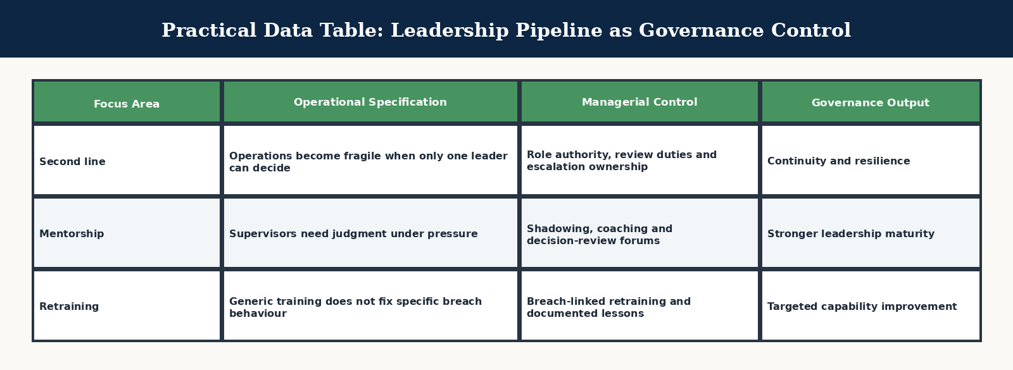
The second line is not only a leadership development issue. It is an internal control. In many complex operations, the second-line manager is expected to interpret SOPs, manage frontline behaviour, communicate with clients, control escalation and protect service delivery, yet the role is rarely specified with enough precision.
A practical leadership pipeline must define decision authority, review responsibility, escalation ownership and breach response. Mentorship should transfer judgment, not only technical knowledge.
This aligns strongly with a governance-led leadership profile: building accountable leadership pipelines, resilient operating systems and execution consistency across people, process and client delivery.
Practical Leadership Actions
· A second-line manager should prevent dependency on one senior leader.
· Mentorship must transfer judgment, not only knowledge.
· Leadership development should be tied to breaches and operating evidence.
Data table
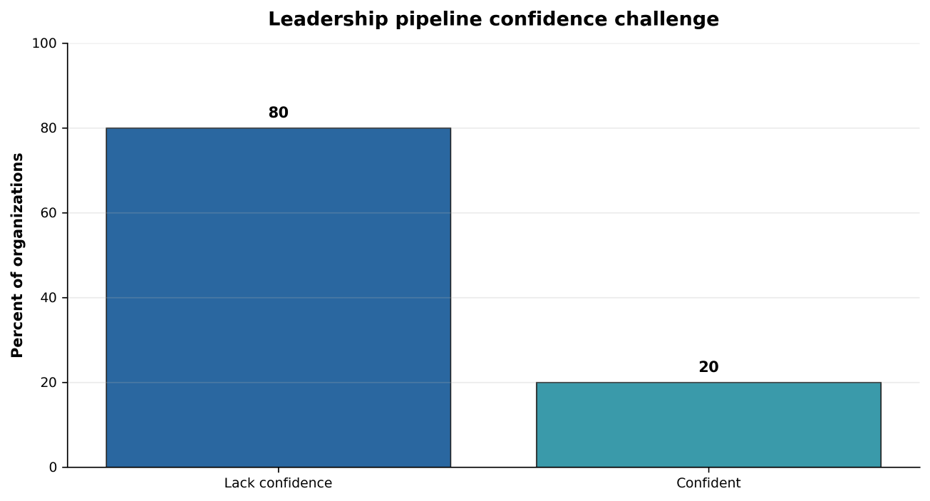
Confidence challenge pipeline.
90-Day Practical Governance Action Plan
A practical approach -
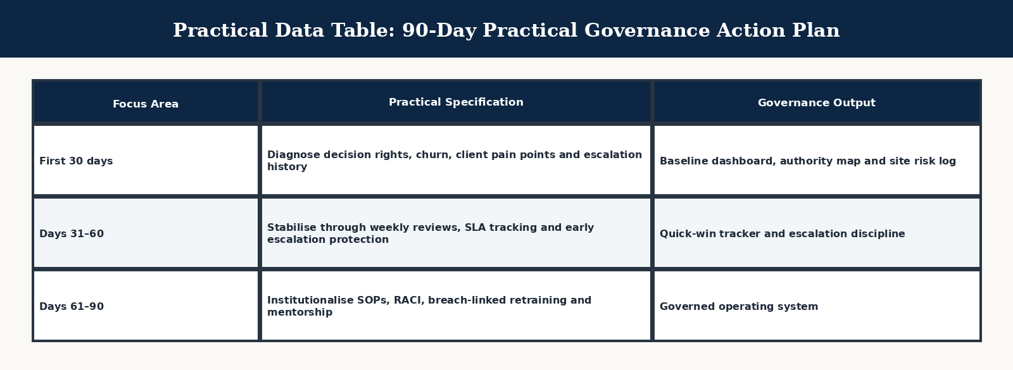
The first step is diagnosis: decision rights, escalation history, site-level variations, manpower churn and client expectations.
The second step is stabilization: weekly operating reviews, SLA tracking, early escalation protection, issue closure dashboards and supervisor accountability.
The third step is institutionalization: SOP correction, RACI, breach-linked retraining, second-line mentoring and board/CXO-ready operating evidence.
Practical Leadership Actions
· Diagnose decision rights, escalation gaps and site-level variation.
· Stabilise through review rhythm, SLA tracking and second-line accountability.
· Institutionalise SOPs, RACI, breach-linked retraining and leadership reviews.
Data table
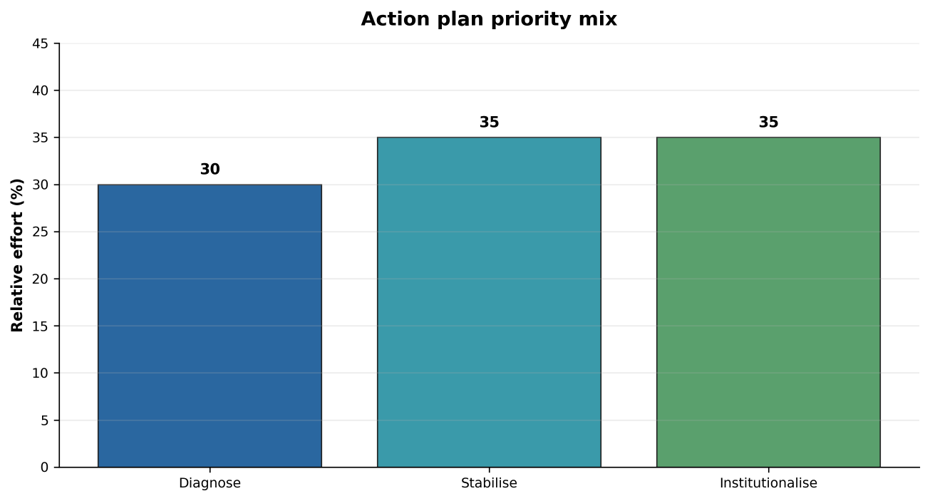
Action Plan Priority Matrix
Conclusion: Build the Specification First
Leadership challenges in complex operational environments are real, especially where judicial service expectations are high and frontline conditions are difficult. But the answer is not to assume that every performance gap is a manpower-quality issue.
The more practical and governance-aligned conclusion is this:
- Define the operating specification first.
- Specify decision rights. Specify escalation thresholds.
- Specify second-line controls.
- Specify the SLA clock.
- Specify breach-linked retraining.
- Then train managers on that specification.
This approach is cheaper than generic training, more resilient than individual heroics and better suited to high-churn distributed operations. It also reflects the deeper governance principle that sustainable performance comes from controlled systems, accountable leadership and reliable evidence—not from firefighting alone.
90-Day Governance Implementation Table
About Author

Research Sources and Profile Alignment