Integrating ESG into Core Operations
Clearly Understanding the Environment, Social and Governance Connection
A practical article on how ESG becomes real when sustainability is embedded into energy, infrastructure, records, supply chains, digital systems and controls
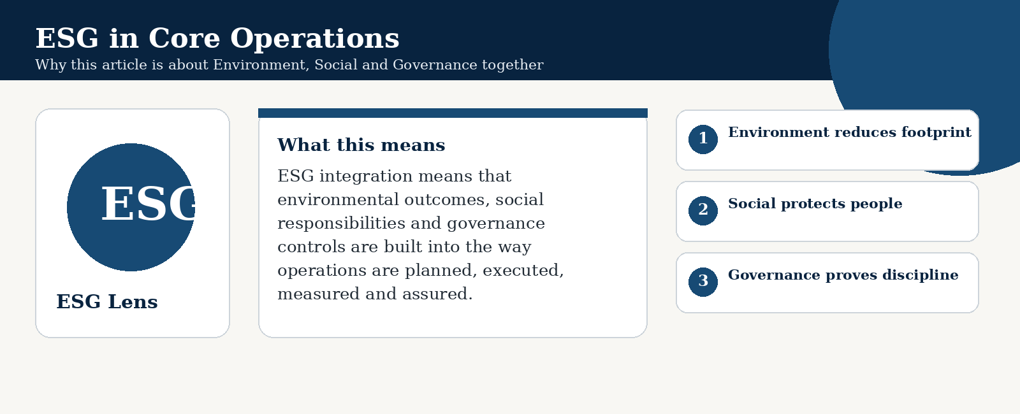
This article explains ESG in a practical way. ESG stands for Environment, Social and Governance, but in many organisations these three words remain abstract until they are connected with day-to-day operations. My central argument is simple: ESG becomes meaningful only when it is embedded into how a company consumes energy, manages buildings, protects records, selects suppliers, governs digital data, and validates internal controls.
The Environment pillar is about reducing the organisation's impact on natural resources through energy efficiency, renewable energy, green infrastructure, reduced paper usage, better water management, cloud efficiency and emissions visibility. The Social pillar is about protecting people and stakeholders through privacy, inclusion, ethical procurement, supplier labour standards, employee records, safe workplaces and responsible handling of sensitive data. The Governance pillar is about the structure that makes ESG reliable: board oversight, ESG committees, ownership, policies, internal controls, audit trails, source-to-report traceability and assurance readiness.
Therefore, this article is not a general sustainability note. It is a business operations article that shows how E, S and G are connected to practical actions. ESG reporting is necessary, but reporting alone is not enough. A business must be able to prove that environmental actions are measured, social responsibilities are protected, and governance controls are strong enough to make disclosures credible. [PwC India - Data governance: An enabler for ESG; Accountancy Europe - ESG Governance questions boards should ask].
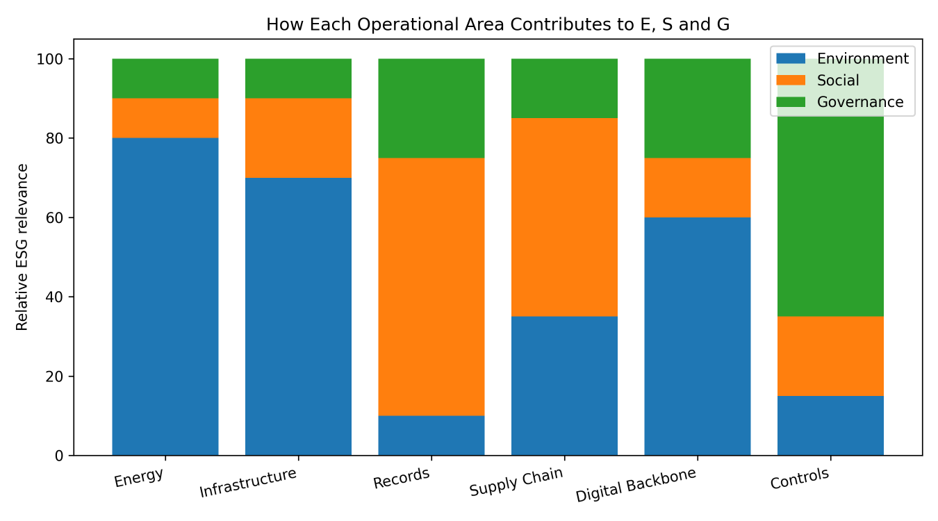
Folowing table show how operaton contributes to ESG...
Environment: Energy use and the transition to net-zero
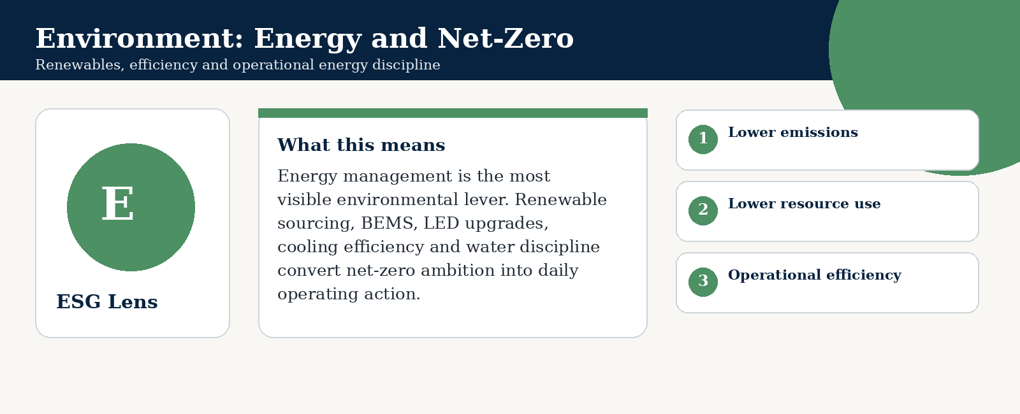
The environmental connection begins with energy. Every organisation consumes energy directly or indirectly through offices, branches, production facilities, warehouses, data infrastructure and service delivery networks. If this consumption is not measured and improved, the organisation cannot seriously claim environmental maturity. Renewable electricity sourcing, including instruments such as Guarantees of Origin, helps companies move toward cleaner energy. However, renewable sourcing must be supported by internal efficiency because clean procurement alone does not remove wasteful consumption.
Efficiency interventions such as Building Energy Management Systems, LED lighting, efficient air-conditioning, water-efficiency measures and planned maintenance help convert environmental ambition into operational discipline. This is where Environment connects with operational excellence. Lower energy use means lower emissions, but it also means better cost control, better asset management and better process discipline.
A clear tabular explanation can easily explain how the E of ESG deals with emissions, energy, water, resource usage and net-zero progress. A business that reduces wasteful consumption is not only improving its environmental footprint; it is also building a more efficient operating model [Persistent Systems ESG Sustainability Report 2025; McKinsey - ESG metrics: From checklists to capabilities].
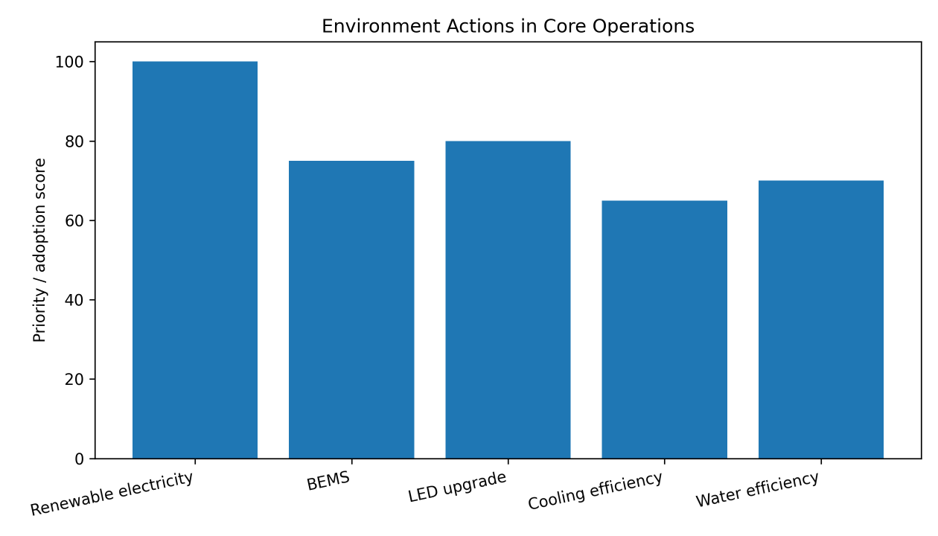
Graph 2: Environment actions in energy and net-zero operations
Environment: Branches, buildings and infrastructure
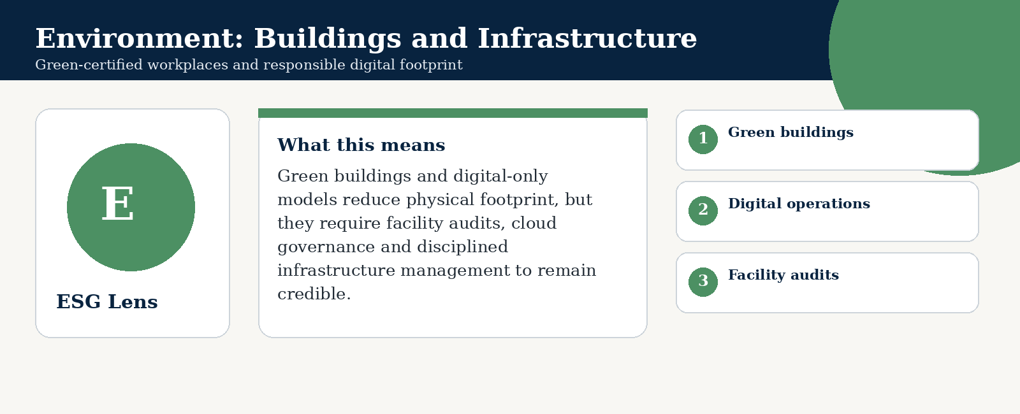
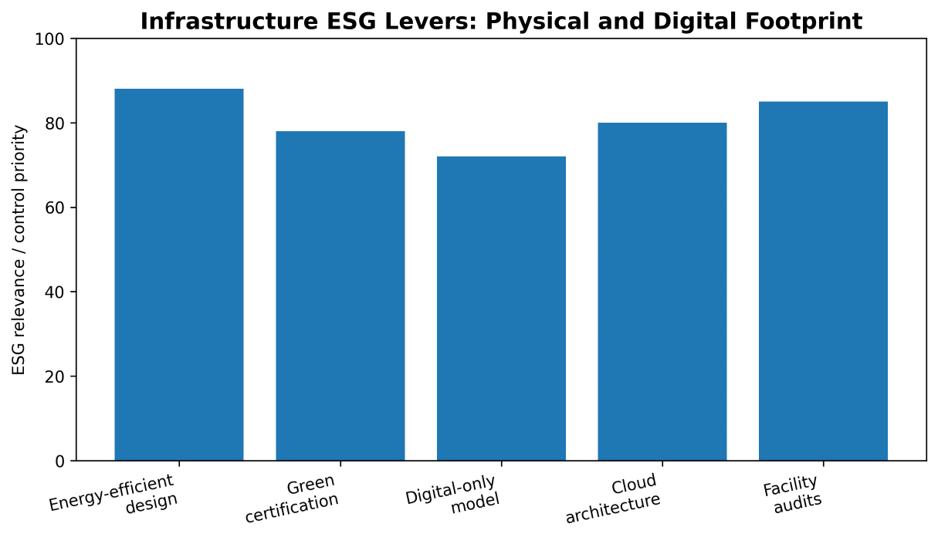
The Environment pillar also appears in how physical infrastructure is designed and operated. Branches, offices, warehouses and production sites influence energy demand, employee comfort, water use, waste generation and maintenance cost. Green-certified spaces, modern energy-efficient design, LEED principles and WELL-style workplace standards show that infrastructure has a direct ESG role.
Digital-only operating models can also reduce physical footprint by reducing branch dependency, paper usage and local infrastructure load. However, digital operations are not automatically sustainable. They must still be supported by efficient cloud architecture, responsible data storage and secure digital workflows. A digital model may reduce physical consumption, but it creates new governance responsibilities around cloud, cybersecurity, data retention and technology lifecycle.
Let's see how it relates to Environment because it focuses on the physical and digital footprint of the organisation. Buildings consume resources, infrastructure creates emissions, and digital storage consumes energy. The ESG question is whether the company is designing and operating these assets responsibly. [LEED and WELL references in LMNotes; Egiss - ESG in IT is about governing decisions].
Social: Responsible records management and data privacy
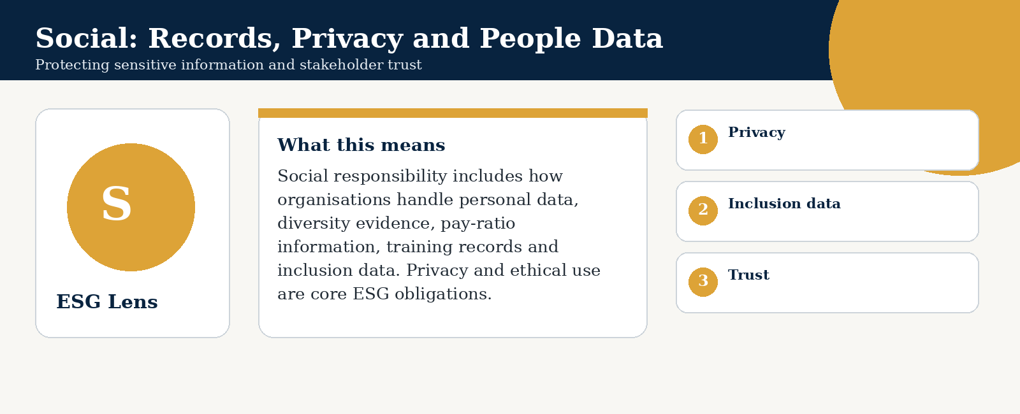
The Social pillar is often misunderstood as only community welfare or employee engagement. In modern ESG, Social also includes how an organisation protects people through data privacy, fair handling of sensitive information, inclusion data governance and ethical records management. Personal data, diversity information, pay ratios, training records, grievance data and inclusion evidence all relate to people. If this information is mishandled, the organisation creates social harm and trust risk.
This is why responsible records management is central to ESG. Companies must protect personal data from leakage, unauthorised access, misuse or improper processing. Regulations such as GDPR have made privacy a formal compliance issue, but the deeper ESG issue is trust. Employees, customers, suppliers and stakeholders must believe that the organisation handles sensitive information ethically and securely.
This is about a clear presentation about the S of ESG because it protects people. Privacy, inclusion, fairness, labour-related information and stakeholder trust are social responsibilities. However, this Social responsibility becomes credible only when supported by strong Governance controls such as access rights, retention schedules, audit trails and validation workflows. [PwC India; Accountancy Europe].
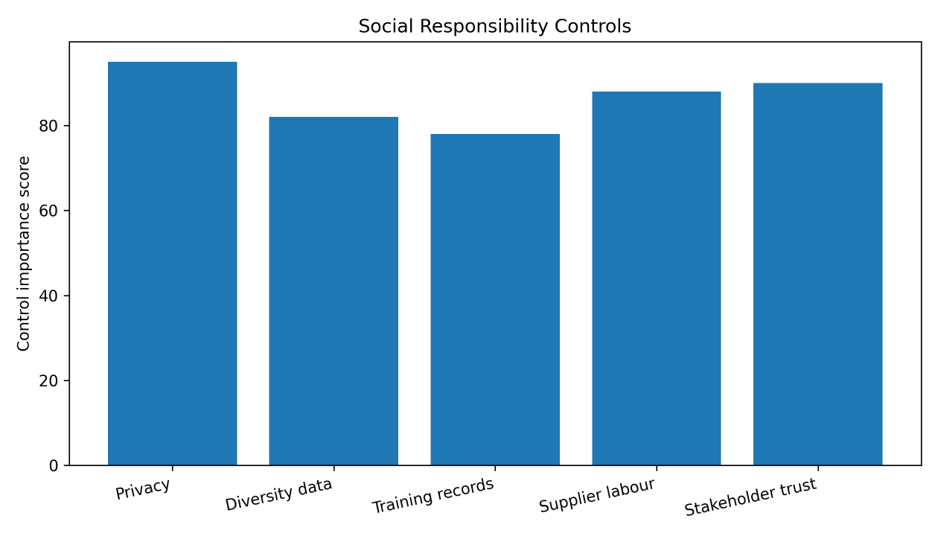
Graph 3: Social responsibility controls
Social: ESG-driven supply-chain practices
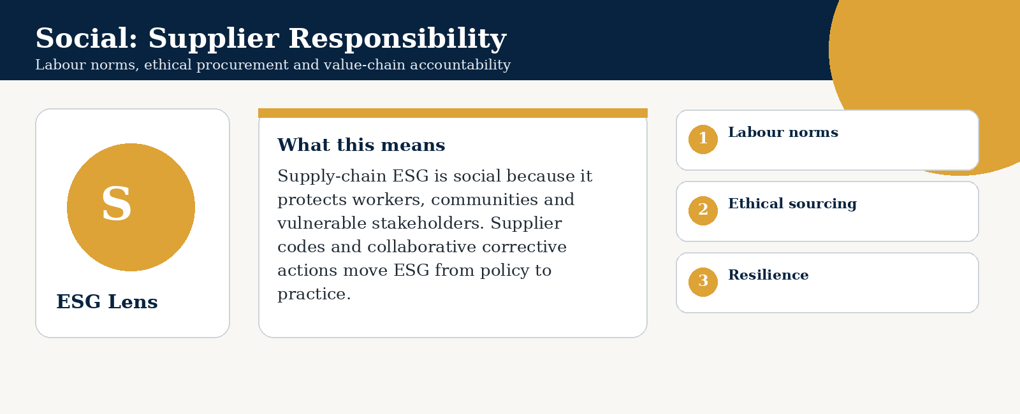
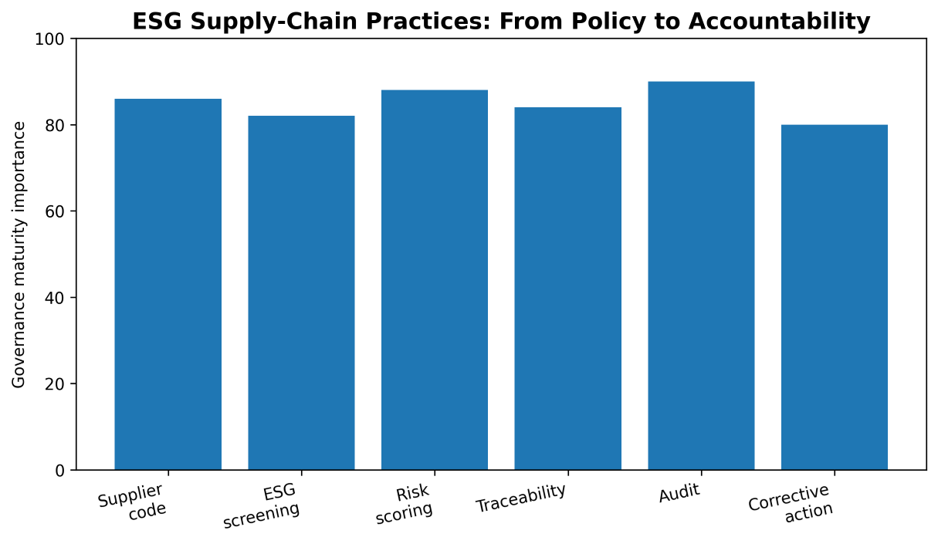
Supply chains are one of the strongest examples of the Social pillar because supplier practices affect workers, communities, customers and the wider value chain. A company may have strong internal policies, but if suppliers violate labour norms, safety standards or ethical sourcing expectations, the company's ESG risk remains high. This is why supplier codes of conduct, ethical procurement and supplier monitoring are not administrative activities. They are social responsibility mechanisms.
A mature ESG supply-chain model does not depend only on immediate termination when a violation is found. In many situations, collaborative resolution is more responsible. The organisation should assess severity, agree corrective action, monitor improvement and build supplier capability where possible. This approach supports long-term resilience and improves standards across the value chain.
This relates to Social because it focuses on labour norms, ethical sourcing, supplier behaviour and stakeholder trust. It is also linked to Governance because supplier codes, scorecards, audit clauses and traceability systems are needed to make supplier accountability real. [Boston Consulting Group - Bringing ESG Accountability to Global Supply Chains].
Governance: Digital storage and the ESG data backbone
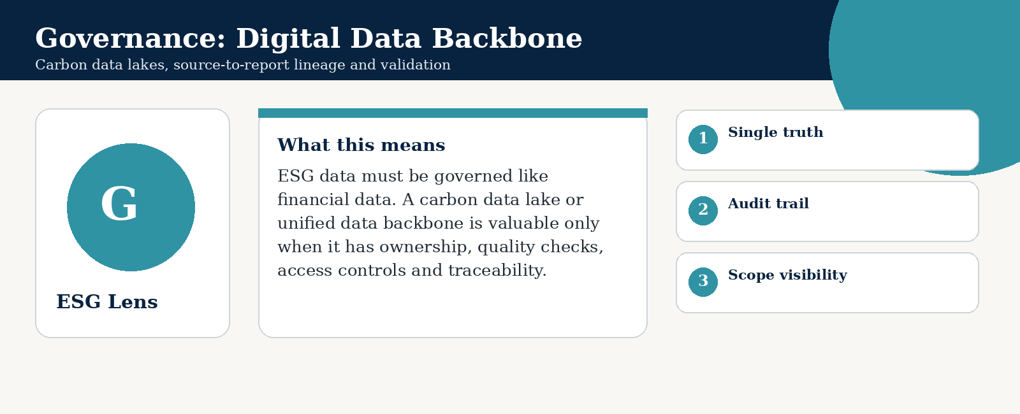
Governance is the backbone of credible ESG. Without reliable data architecture, ESG reporting becomes a collection of claims rather than a controlled management system. ESG data is often spread across ERP systems, carbon accounting platforms, HR records, procurement databases, facility systems, supplier portals and audit registers. If these sources are disconnected, the organisation will struggle to report accurately on Scope 1, Scope 2 and Scope 3 emissions.
A digital ESG backbone, sometimes supported by carbon data lakes, helps consolidate information. However, storage alone is not governance. The data backbone must include data ownership, access control, version control, validation checks, source-to-report lineage and availability of evidence. Only then can the organisation explain how a number travelled from an operational source to a board dashboard or public disclosure.
The digital data backbone is surely related to Governance because it explains how ESG information is controlled, validated and evidenced. It also supports the Environment pillar because emissions data becomes more reliable, and it supports the Social pillar because sensitive people-related data is better protected. [PwC India; Egiss; McKinsey].
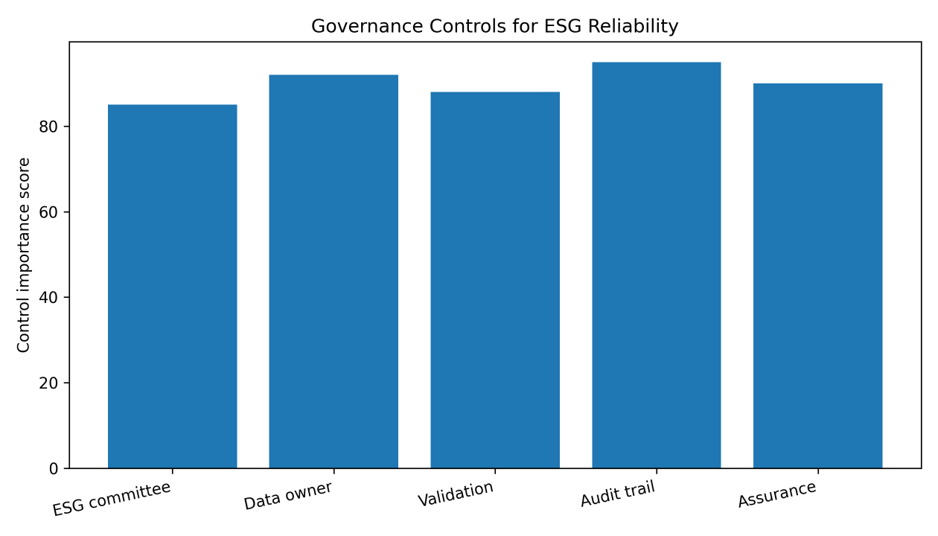
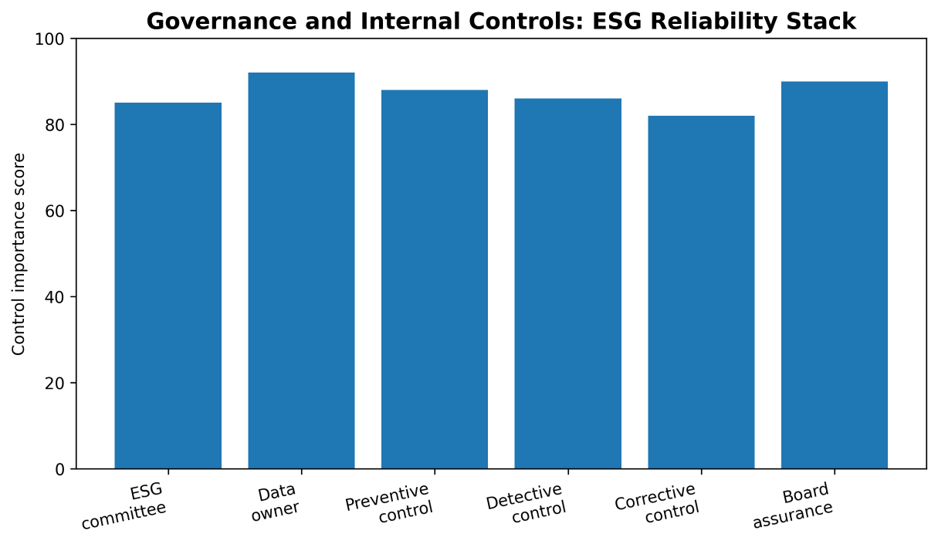
Graph 4: Governance controls for ESG reliability
Governance: Committees, accountability and internal controls
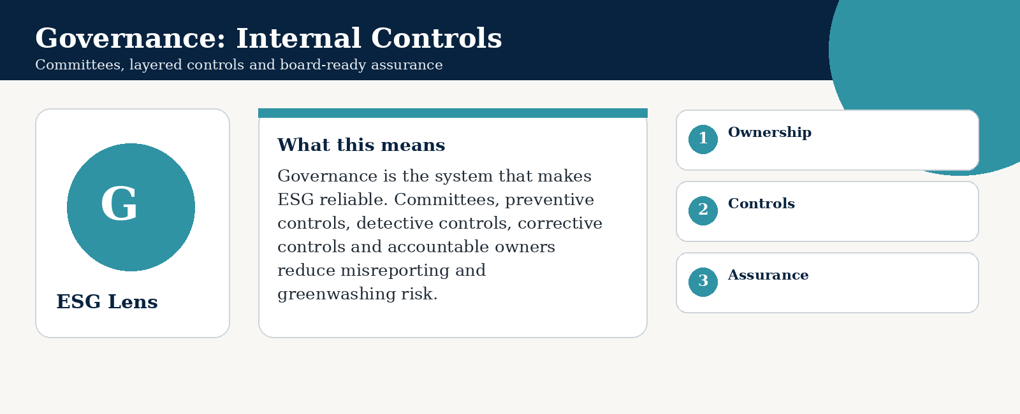
Operational ESG requires formal oversight. An ESG committee should include representation from finance, HR, operations, technology, procurement, risk and compliance because ESG touches every function. Finance understands reporting discipline, HR owns workforce and diversity data, operations owns energy and safety, procurement owns supplier risk, and technology owns digital infrastructure and data controls. A diverse ESG committee helps convert sustainability intent into realistic day-to-day implementation.
Internal controls are equally important. Preventive controls stop errors before they happen. Detective controls identify inconsistencies, policy breaches or unusual patterns. Corrective controls ensure that problems are resolved and do not repeat. These controls must operate at the source of the transaction, not only at the final reporting stage. For example, supplier data should be validated during onboarding, energy data should be checked before consolidation, and privacy access should be monitored continuously.
The Internal Controls is directly related to the G of ESG because it deals with oversight, accountability, control design, evidence, validation and assurance. Governance is what prevents ESG from becoming greenwashing. It gives the board confidence that environmental and social claims are backed by reliable systems. [COSO control toolkit references in LMNotes; Accountancy Europe; PwC India].
How E, S and G work together
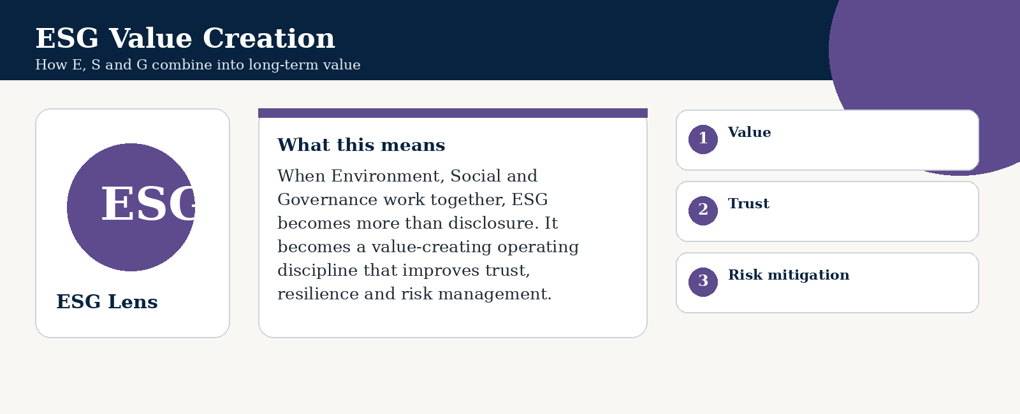
The most important point for the audience is that Environment, Social and Governance are not separate boxes. They work together. Energy efficiency is Environmental, but it also needs Governance through measurement, targets and controls. Data privacy is Social, but it also needs Governance through access control and audit trails. Supplier responsibility is Social, but it may include Environmental requirements and must be governed through contracts, scorecards and audits.
This is why ESG integration is more powerful than ESG reporting. Reporting tells stakeholders what the company says it is doing. Integration shows how the company actually operates. A company that integrates ESG into its operating rhythm can show environmental reduction, social responsibility and governance evidence in one connected system.
For boards and CXOs, the message is clear. ESG should not be left to a reporting team alone. It should be owned by the business, reviewed by leadership, controlled by process owners and evidenced through data. That is how ESG creates long-term value, reduces risk and builds trust. [McKinsey; PwC India; Boston Consulting Group; Accountancy Europe].
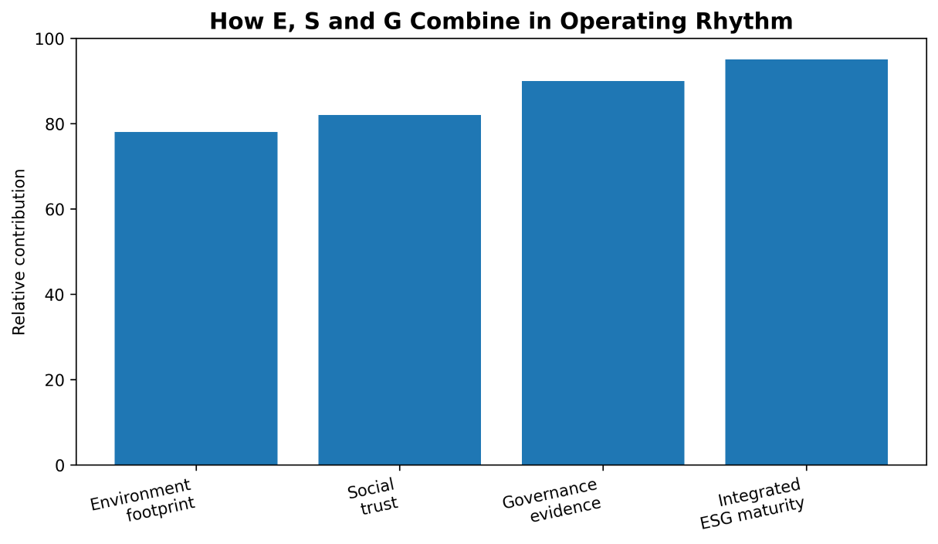
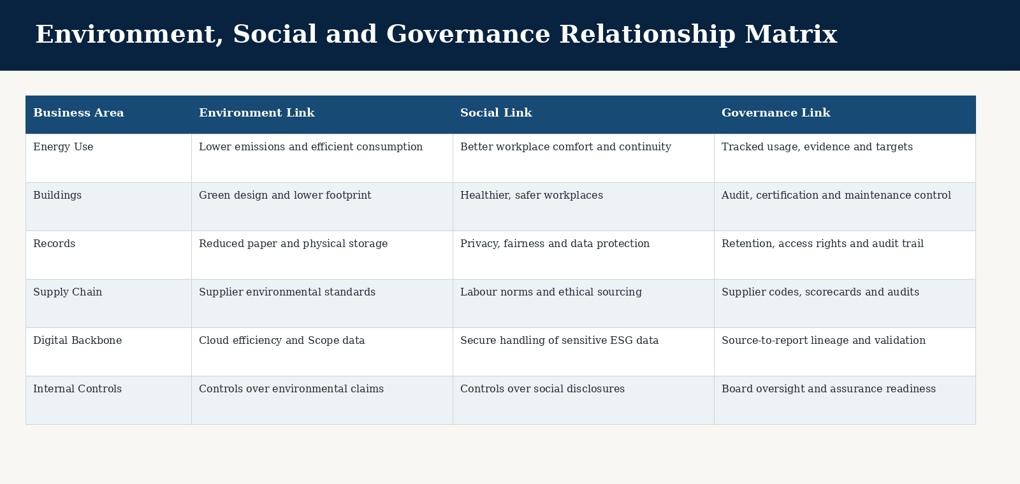
Table Visual: How business areas connect with Environment, Social and Governance
Closing perspective
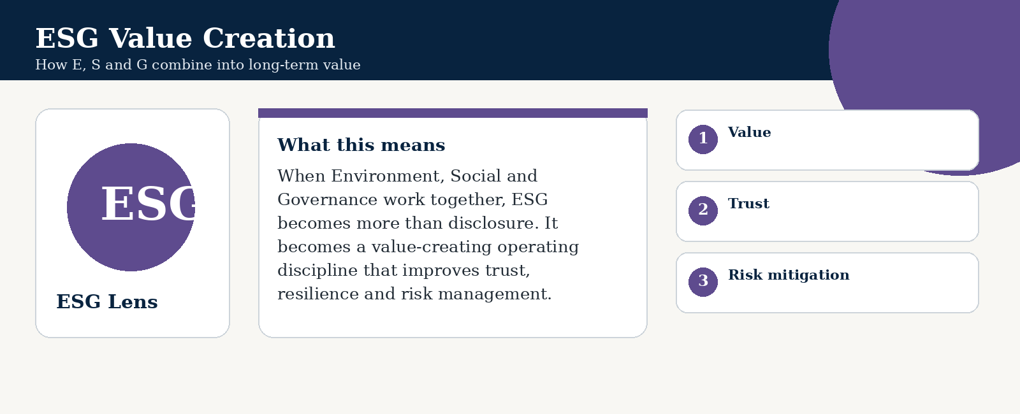
To conclude, the article is about ESG because it explains each ESG pillar in operational language. Environment is visible in energy, buildings, emissions, water efficiency and digital footprint. Social is visible in privacy, employee data, inclusion, supplier labour standards and stakeholder trust. Governance is visible in committees, ownership, controls, audit trails, data validation and board oversight.
My view is that ESG maturity should be judged by operating discipline, not by report length. A company may publish a long sustainability report and still have weak ESG maturity if its data is fragmented, suppliers are not governed, privacy controls are weak, energy use is not monitored and board oversight is inconsistent. On the other hand, a company with strong operating controls, clear ownership and traceable evidence can build genuine sustainability credibility.
Therefore, ESG integration must become a management habit. It should influence how energy is consumed, how infrastructure is planned, how records are protected, how suppliers are selected, how digital data is governed and how internal controls are tested. This is the practical meaning of Environment, Social and Governance in business operations. [PwC India; McKinsey; Accountancy Europe; Boston Consulting Group].
Quick ESG Relationship Table

Sources Referenced