From MIS to Board Intelligence: How Boards Can Convert Operational Data into Better Oversight
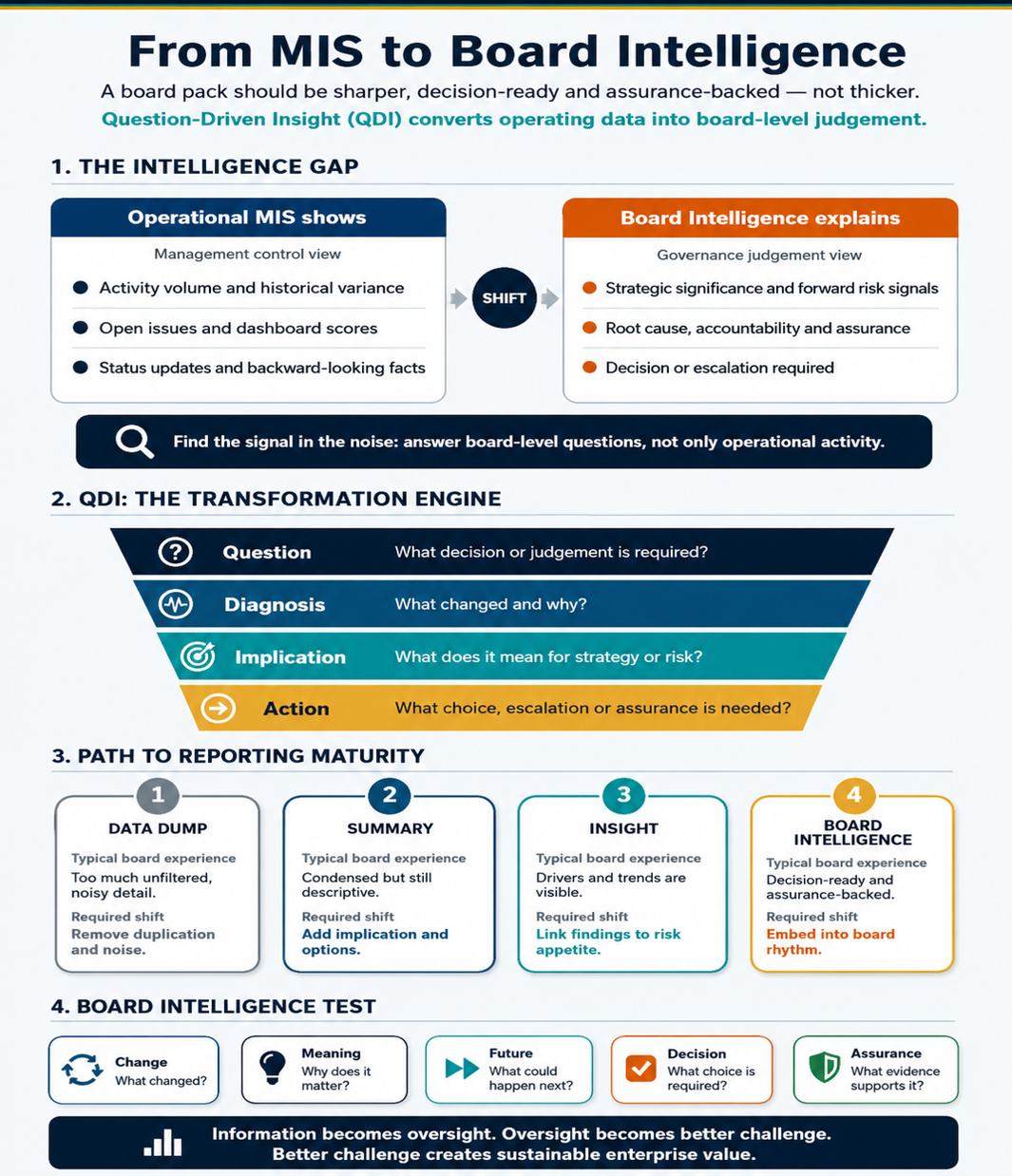
Modern boards are not short of information. They are short of intelligence that is structured for judgement. In many organizations, the board pack has become a heavy accumulation of MIS tables, departmental dashboards, compliance trackers, project updates and retrospective commentary. These reports may be accurate, timely and well-intentioned, but they often leave directors with the most difficult work: finding the signal inside the noise.
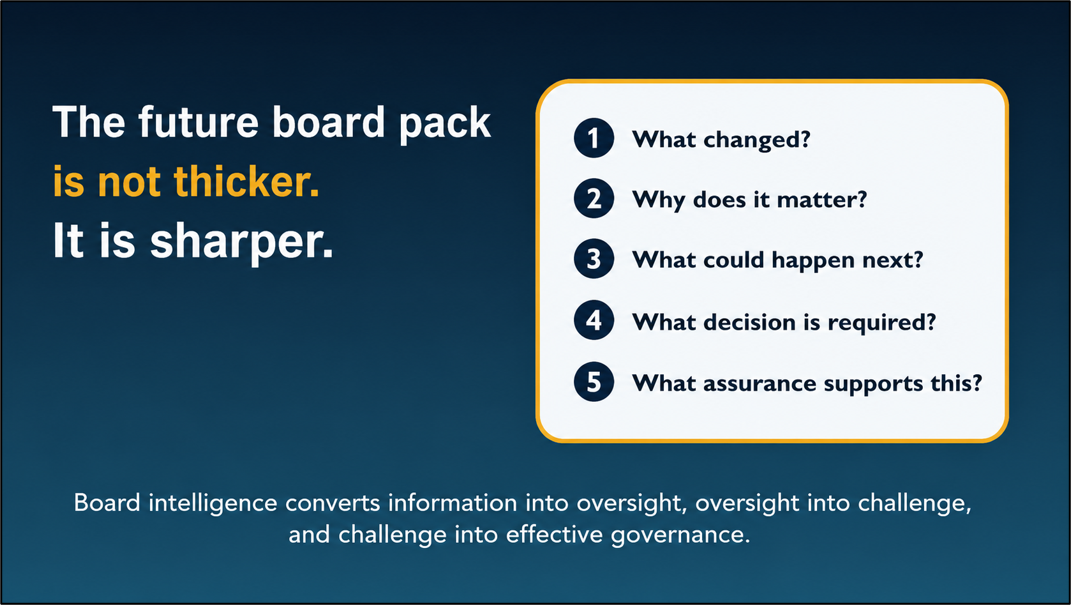
The shift required is not a cosmetic redesign of reports. It is a governance upgrade. Board intelligence converts operating data into oversight by asking sharper questions: what has changed, why has it changed, what could happen next, what does it mean for strategy or risk appetite, and what decision or assurance is required from the board? This article is written from the lens of an aspirant independent director who brings operations excellence and internal audit experience to the boardroom—two disciplines that are particularly valuable when boards need to connect process reality, control effectiveness and strategic direction.
The boardroom problem: data has grown faster than judgement
Visual insight: The boardroom problem: data has grown faster than judgement
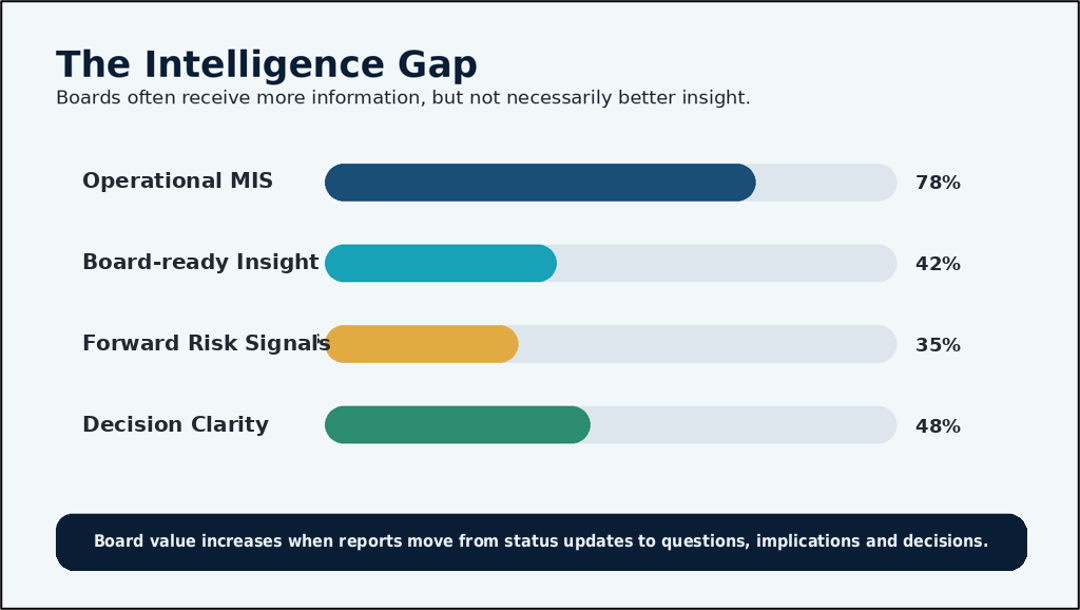
Corporate governance has moved beyond periodic compliance review. Directors are now expected to oversee strategy, risk, cyber resilience, artificial intelligence, culture, stakeholder confidence, ESG commitments, supply-chain fragility and regulatory conduct. The complexity of the agenda has expanded faster than the quality of reporting. As a result, many boards receive more pages but fewer conclusions.
Traditional MIS is usually designed for management control. It tells the organization whether activities are happening: how many transactions were processed, how many audit observations are open, whether costs are within budget, or how many projects are delayed. Board oversight requires a different altitude. Directors must know whether the trend is material, whether the variance affects strategy, whether the control weakness is isolated or systemic, and whether management’s response is adequate.
The intelligence gap appears when reporting answers operational questions but not board questions. Directors do not need to run the business; they need to understand whether management is running it within agreed strategy, risk appetite, ethics and control boundaries. That distinction is the heart of board effectiveness.

Question-Driven Insight: starting with the board question
Visual insight: Question-Driven Insight: starting with the board question
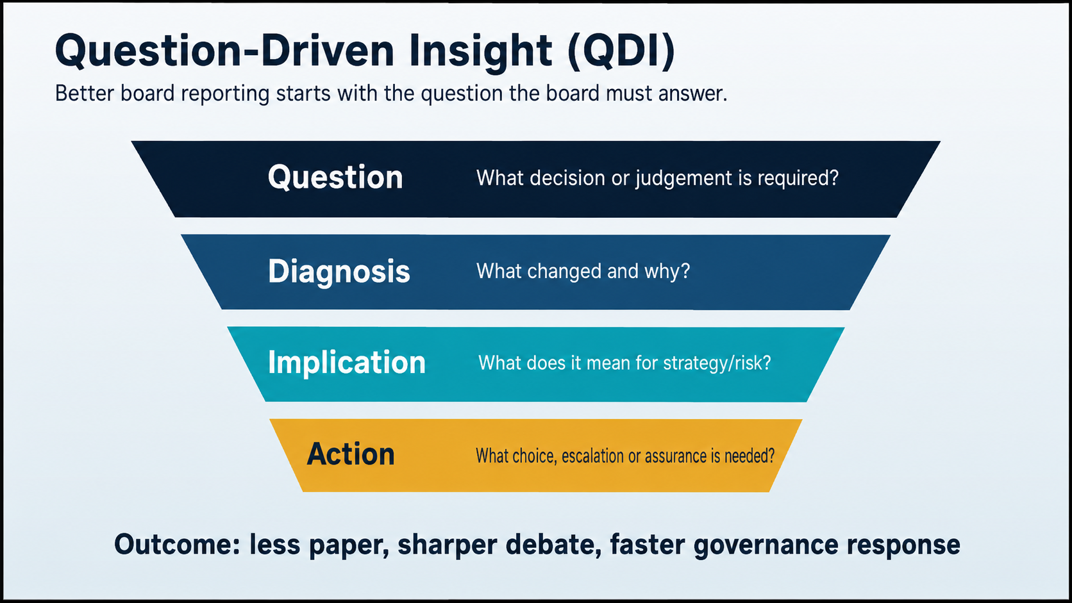
Question-Driven Insight, or QDI, is a practical way to transform reporting quality. Instead of beginning with all available data, the report begins with the question the board must answer. This simple shift changes the whole reporting discipline. It forces management to separate background information from judgement, opinion from evidence, and activity from consequence.
A QDI-based board paper does not hide behind excessive detail. It states the issue, frames the context, gives the board the choices available, sets out the risks and trade-offs, and makes clear what is being requested. It also improves boardroom debate because directors arrive with the same problem definition. The conversation then moves from clarification to challenge, from explanation to decision, and from passive review to active oversight.
For an independent director, QDI creates a powerful platform for constructive challenge. It allows the director to ask whether the right question has been framed, whether management has considered alternative scenarios, whether the assurance evidence supports the conclusion, and whether the recommended decision is consistent with risk appetite and long-term value.

From data dump to intelligence maturity
Visual insight: From data dump to intelligence maturity
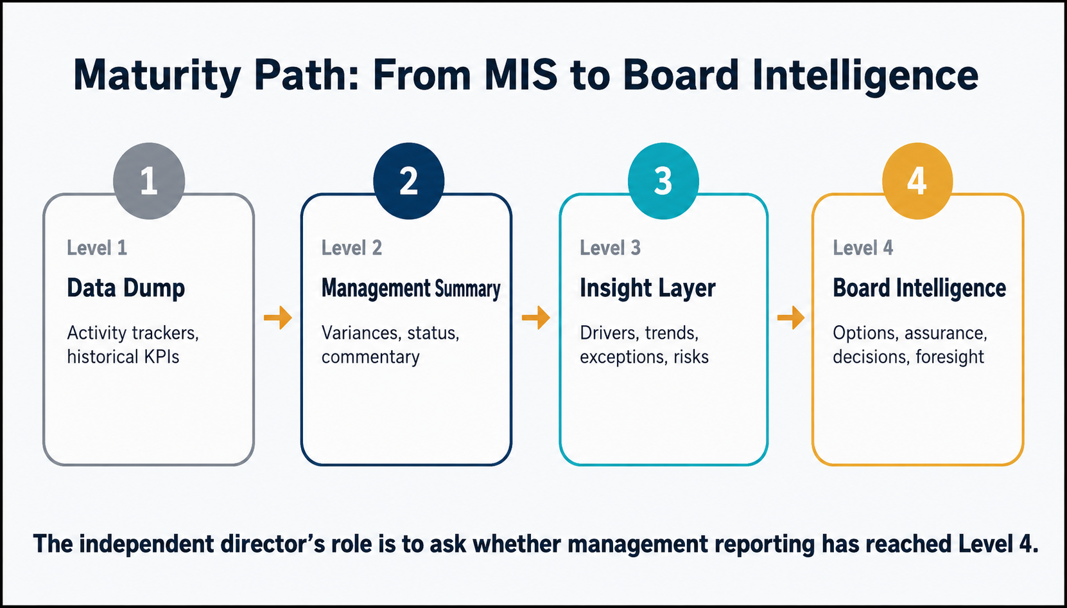
Board reporting maturity is best understood as a progression. At the lowest level, boards receive data dumps: long tables, unfiltered dashboards and narrative updates. At the next level, management summaries compress those facts but still remain largely descriptive. More mature reporting adds insight: what changed, what caused it, where exceptions exist and what trends matter. The highest level is board intelligence, where information is converted into options, risk choices, assurance conclusions and future implications.
This maturity path is important because the board cannot improve oversight simply by asking for shorter reports. A short report can still be weak if it lacks critical thinking. Equally, a detailed report can be valuable if the structure is right and the appendix supports the decision without overwhelming the main paper. The issue is not length alone; it is relevance, hierarchy and judgement.
Operational excellence experience is valuable here because it recognizes process symptoms before they become enterprise failures. Internal audit experience is equally valuable because it tests whether evidence is reliable, controls are operating, and management actions are closing root causes rather than only treating symptoms. Together, these lenses help a board ask better questions about the quality of information it receives.

A better board pack architecture
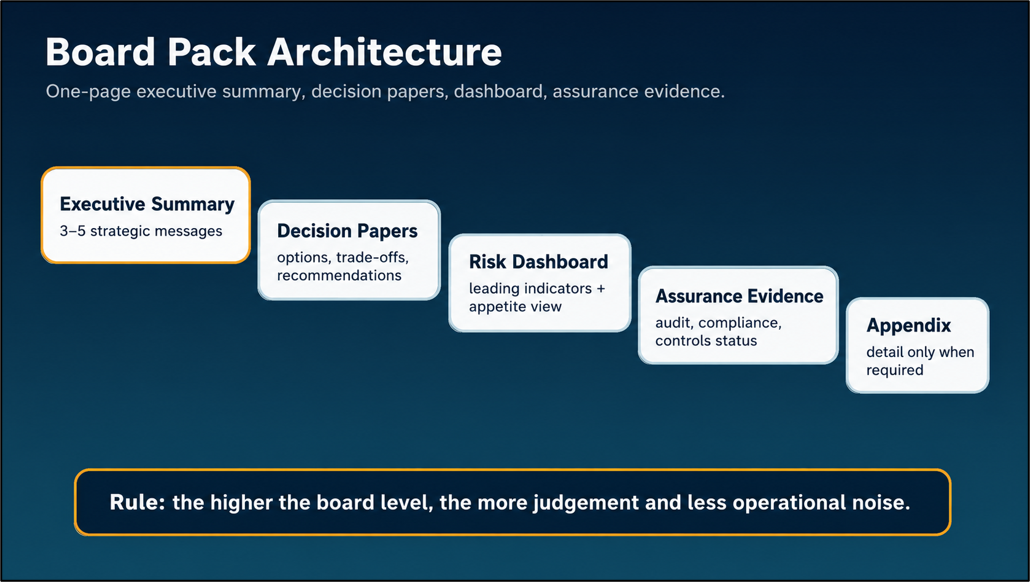
Visual insight: A better board pack architecture
Aboard pack should be built like an intelligence product, not a file repository. The front of the pack should contain an executive summary that highlights strategic movement, risk changes, decisions required and matters for challenge. Decision papers should be structured around choices and consequences. Risk dashboards should show leading indicators, trend movement and appetite breaches. Assurance evidence should be concise but credible. Detailed operational data should remain available in appendices, not dominate the discussion.
This architecture respects directors’ time while improving governance quality. It also improves management accountability. When management is required to state the decision request, the risk implication, the alternative considered and the evidence base, weak thinking becomes visible early. The board can then ask targeted questions before issues become expensive failures.
Digital board intelligence platforms and GRC tools can help by connecting risk registers, control testing, incidents, policy attestations, audit issues, third-party risks and compliance obligations. However, technology is not the answer by itself. Without disciplined reporting principles, a digital dashboard can become a faster version of the same old noise. The operating model must come first; technology should enable it.

Dynamic dashboards for oversight, not decoration
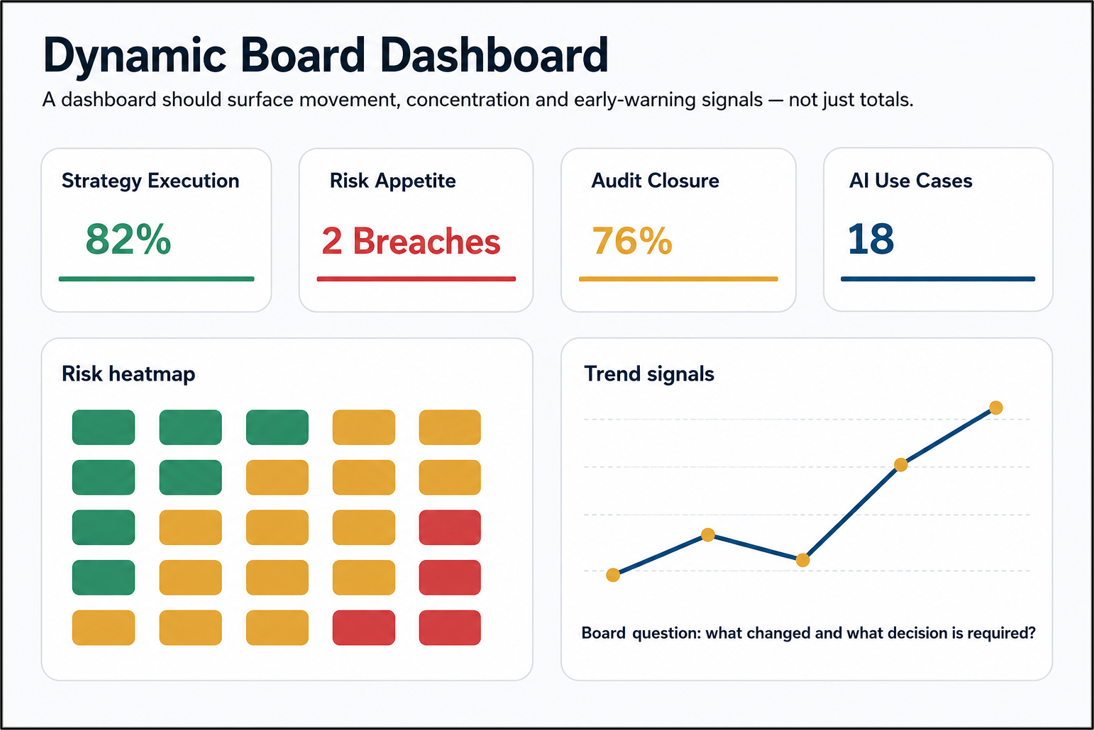
Visual insight: Dynamic dashboards for oversight, not decoration
Board dashboards are most useful when they show movement, threshold breaches and emerging concentration—not when they merely display attractive charts. A red-amber-green dashboard that never changes may create false comfort. A dashboard that shows leading indicators, control health, incident velocity, customer impact, regulatory exposure and financial consequence gives directors a stronger basis for oversight.
Good dashboard design begins with the board’s risk appetite and strategic priorities. If cyber resilience is a strategic risk, the board needs indicators that show vulnerability exposure, response time, third-party dependency and tested recovery capability. If AI is a growth driver, the board needs visibility into AI use cases, data lineage, model risk, bias testing, privacy impact and accountability. If operational resilience is critical, directors need to see process bottlenecks, exception trends and recovery performance.
The most valuable dashboards are not static. They allow trend comparison, ownership, escalation and drill-down. They also separate management metrics from board metrics. Management may need hundreds of operating indicators. The board needs a smaller number of critical signals that trigger the right debate.

The assurance loop: where Ops Excellence and IAF experience add value
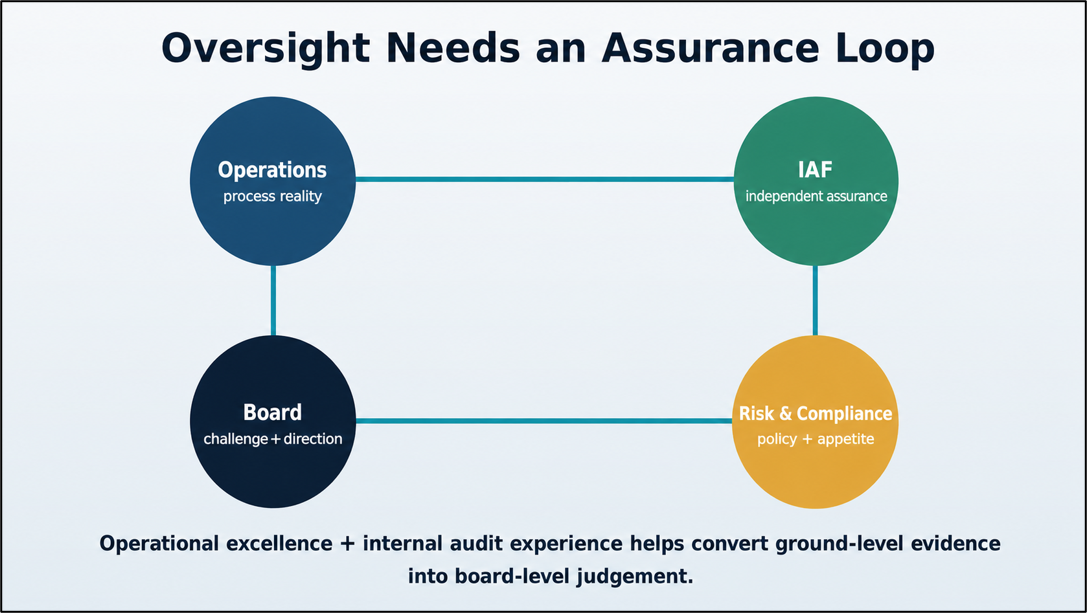
Visual insight: The assurance loop: where Ops Excellence and IAF experience add value
Board intelligence is strongest when it is supported by an assurance loop. Operational data tells the board what management believes is happening. Internal audit, risk, compliance and control testing help directors understand whether those claims are reliable. The value lies in triangulation: operations show performance, risk teams show exposure, audit shows control reliability, and the board applies judgement.
This is where an aspirant independent director with operations excellence and internal audit experience can bring distinctive value. Operations excellence develops the ability to read process flow, waste, bottlenecks and failure modes. Internal audit develops independence, evidence discipline, root cause analysis and control thinking. In the boardroom, this combination helps convert management information into better questions rather than operational interference.
The board should not ask directors to manage processes. But it should benefit from directors who understand how process issues become enterprise risks. When the board sees a recurring customer complaint, a failed control, a delayed transformation milestone or an exception trend, a director with this background can ask whether the issue is isolated, whether root cause is known, whether accountability is clear, and whether assurance supports closure.

Modern risks require forward-looking board intelligence
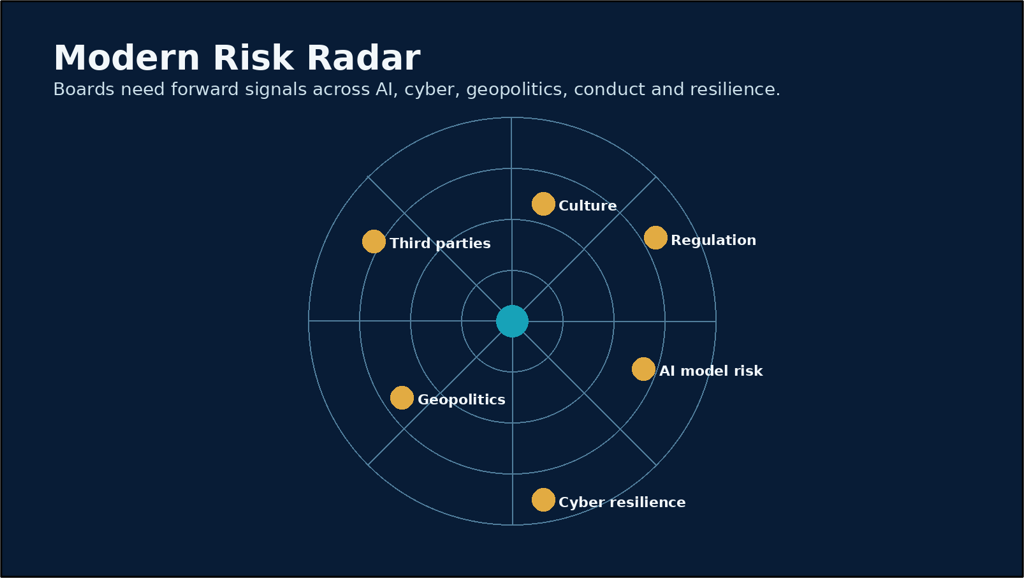
Visual insight: Modern risks require forward-looking board intelligence
Artificial intelligence, cyber exposure, geopolitical instability, third-party concentration and regulatory change are not traditional backward-looking risks. They move quickly, connect across functions and often create impact before governance routines catch up. This is why boards need forward-looking intelligence, not only historical MIS.
AI oversight is a good example. A board cannot govern AI by asking only how many tools have been deployed. It needs to know where AI is used in business-critical processes, what data feeds the models, whether outputs are explainable, who is accountable, what controls exist, and whether the use case is inside risk appetite. Similarly, cyber oversight requires more than incident counts. Directors need to understand exposure, resilience, recovery testing and third-party dependency.
Board intelligence should therefore include risk velocity, control confidence, scenario impact and management readiness. These indicators help directors move from reactive review to anticipatory oversight. The goal is not to predict the future perfectly; it is to see enough early signals to ask the right question before the organization is forced into crisis response.

A 90-day practical upgrade for boards and management
Visual insight: A 90-day practical upgrade for boards and management
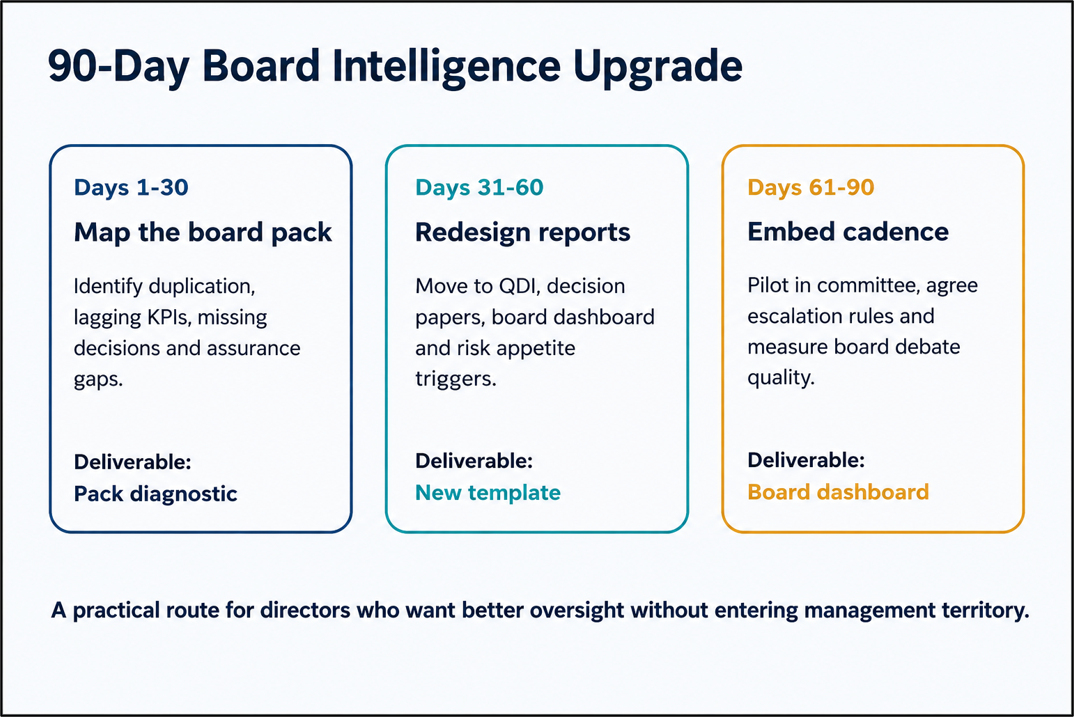
Moving from MIS to board intelligence does not require a multi-year transformation. A practical 90-day upgrade can create visible change. In the first 30 days, the organization can diagnose the existing board pack: duplicate information, late indicators, unclear decisions, excessive appendix material and gaps between strategy, risk and assurance. Directors and management can agree what the board needs to see, not just what functions are used to providing.
In the next 30 days, management can redesign templates around QDI. Every paper should state the question, recommendation, options, risks, financial and operational implications, assurance evidence and decision requested. Dashboards should be linked to risk appetite and strategic priorities. In the final 30 days, the new pack can be piloted in one committee or board cycle, with feedback on clarity, length, debate quality and decision follow-through.
The point is not to create a perfect pack immediately. The point is to create a better governance rhythm. Once the board sees clearer papers and better dashboards, the quality of questions improves. Once questions improve, management thinking improves. Over time, the board pack becomes a tool for strategic partnership rather than a compliance ritual.

Closing perspective: the future board pack is sharper, not thicker
Visual insight: Closing perspective: the future board pack is sharper, not thicker
The future of board effectiveness will not be defined by how much information directors receive. It will be defined by how effectively that information supports judgement. Boards need reports that identify the few issues that matter, explain why they matter, clarify choices, evidence management’s position and create accountability for action.
From MIS to Board Intelligence is therefore a cultural shift as much as a reporting shift. It asks management to communicate with greater discipline. It asks directors to challenge with greater precision. It asks risk, compliance and internal audit teams to connect assurance with strategic oversight. It asks technology platforms to serve governance rather than simply accelerate reporting.
For professionals aspiring to contribute as independent directors, this is a meaningful area of value creation. Operations excellence brings understanding of how organizations actually work. Internal audit experience brings assurance discipline and independence. Together, they can help boards convert operational data into strategic oversight, strategic oversight into better challenge, and better challenge into long-term enterprise value.

Closing Summary: The Zest of Board Intelligence
At its core, this article argues that board effectiveness improves when information is not merely collected, but converted into judgement. MIS tells the board what happened; board intelligence explains what changed, why it matters, what may happen next, and what decision, escalation or assurance is required. This is the real shift from reporting as a routine to reporting as a governance instrument.
The practical message is simple: the board pack should become sharper, not thicker. It should start with the question, connect data with strategy and risk appetite, separate management detail from board judgement, and support every conclusion with credible assurance. Executive summaries, decision papers and dashboards must therefore surface the few signals that deserve board attention, rather than overwhelming directors with operational noise.
For an independent director, especially one bringing operations excellence and internal audit experience, the value lies in constructive challenge. Such a director does not enter management territory; rather, he helps the board test whether risks are understood, controls are reliable, actions are accountable and emerging issues are visible early. When this discipline becomes part of the board rhythm, information becomes oversight, oversight becomes better challenge, and better challenge creates sustainable enterprise value.
In summary, the value of board intelligence is not in reducing pages alone; it is in improving clarity, accountability and assurance. A board pack becomes truly effective when it helps directors see the signal, ask the right question, and guide the organization before risk turns into crisis.
Author Profile & Contact

Sources and research references
• Board Intelligence, QDI Principle and better board pack writing resources.
• Mitratech, Board Reporting and Global GRC Platform resources on dashboards, widgets and risk reporting.
• NACD, board resources on AI governance, cybersecurity oversight and director education.
• McKinsey, insights on board evolution, AI governance and GRC best practices.
• OECD AI Principles and responsible governance references.
• Internal audit and assurance concepts aligned to IIA Three Lines Model and professional practices.