The Governance of Field Performance: A Real Telecom O&M Operational Excellence Case Study
From Reactive Telecom O&M to Governance-Led Execution through Analyze - Act - Adhere
A real Kashmir Network Operation Case Study
Case study, data and the Operational Excellence Framework
Executive Summary
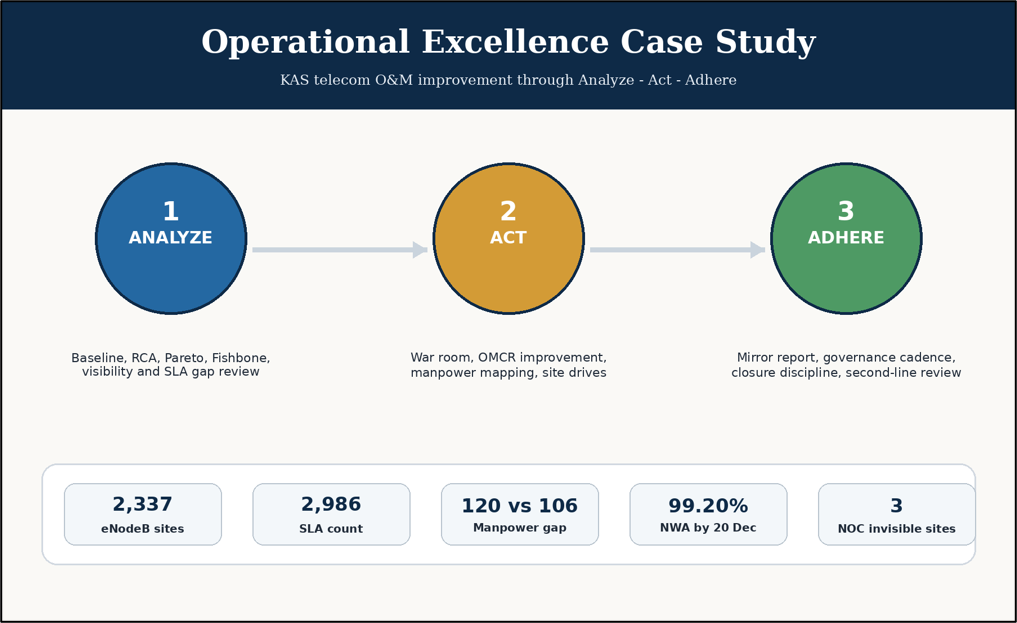
This case study presents a real telecom O&M improvement initiative that I practically implemented on the ground during my tenure as CTO of Deltos Infra. It is a strong example of Operational Excellence Governance in action — covering operational challenges, performance impact, structured methodology, root cause analysis, Pareto prioritization, action planning, field improvement drives, resource support and adherence governance.
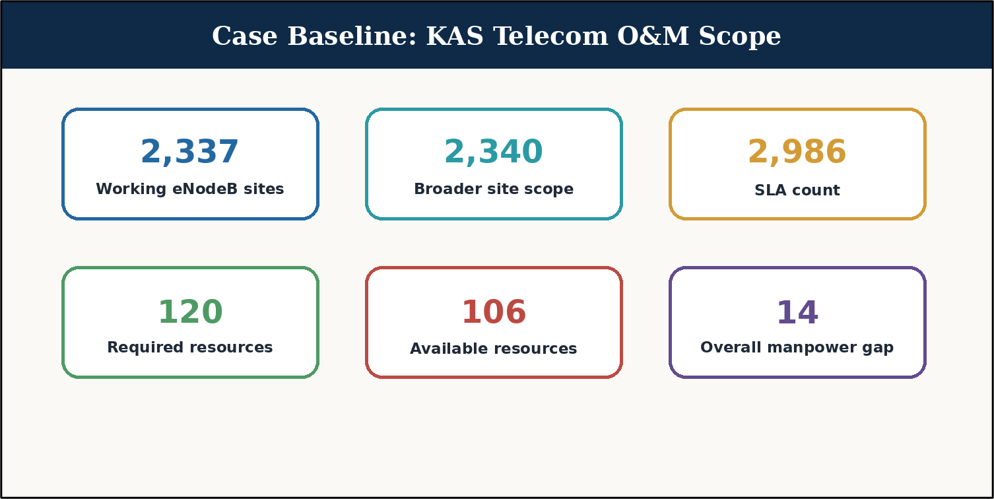
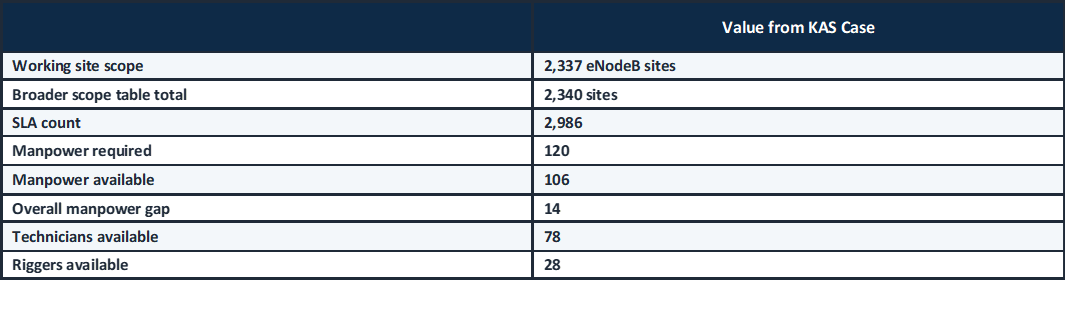
The KAS case involved a large telecom operating circle with a working scope of 2,337 eNodeB sites, a broader scope table of approximately 2,340 sites, and an SLA count of 2,986. At this scale, the operation was facing manpower shortages, NOC visibility gaps, energy stress, uneven accountability and weak review discipline — all of which were directly affecting performance stability and governance control.
This article maps the KAS case data into my structured Analyze – Act – Adhere model. The case clearly demonstrates that operational excellence is not achieved through dashboard reporting alone. It is achieved when root causes are honestly identified, the high-impact 20 percent issues are prioritized, field interventions are executed with clear ownership, and adherence is sustained through a disciplined governance rhythm.
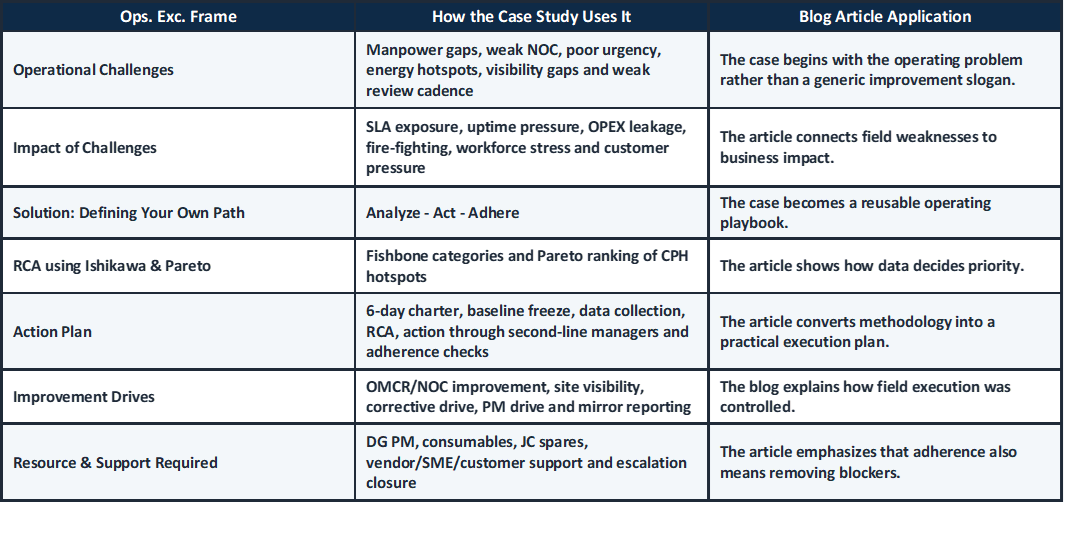
How This Case Study Follows the Operational Excellence Framework
1. The Operational Challenge: Complexity Before Excellence
The Operational Excellence Framework starts by asking a practical question: what are the operational challenges affecting business? In the KAS case, the answer was not one isolated fault. It was a web of interdependent operating problems across people, machines, processes and resources.
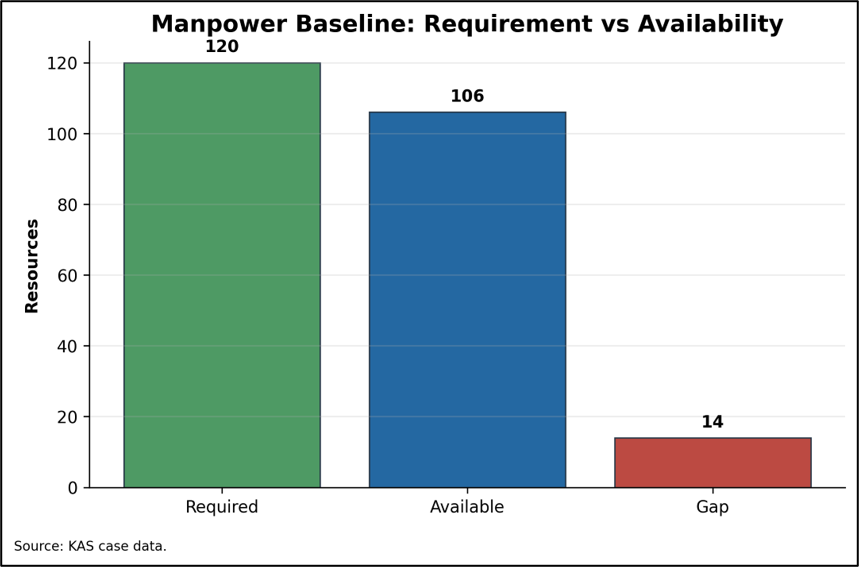
The field network was large, the SLA exposure was high and performance gaps were surfacing through network availability, energy consumption, alarm visibility and field responsiveness. The case also showed that manpower was not simply a numeric shortage; it was a deployment and productivity challenge. The available resource base was 106 against a requirement of 120, creating an overall gap of 14 resources.
In such an environment, leadership cannot depend on individual heroics. The operating system must be redesigned so that the NOC sees issues early, field teams receive the correct alarm quickly, supervisors spend quality time on sites, and leaders review progress through a single control instrument.
2. The Impact: Why These Challenges Hurt the Business
The Ops. Exc. Framework separates operational challenges from their impact. This is important because weak operations do not remain inside the field team. They travel upward into SLA penalties, customer dissatisfaction, revenue leakage, increased operating expense and constant fire-fighting.
At the individual level, overburdened employees face stress, fatigue and performance degradation. At the organization level, repeated failures create penalties, leadership pressure, process violations and higher OPEX. This is why operational excellence must be treated as a business discipline and not as a motivational campaign.
The KAS case is a strong example of this linkage. NOC invisibility meant that some sites could fail silently. Energy outliers pointed to possible control leakage. Manpower gaps created overloading. Weak review mechanisms reduced follow-through. Each issue had an operational form, but the combined impact was strategic: SLA risk and avoidable cost.
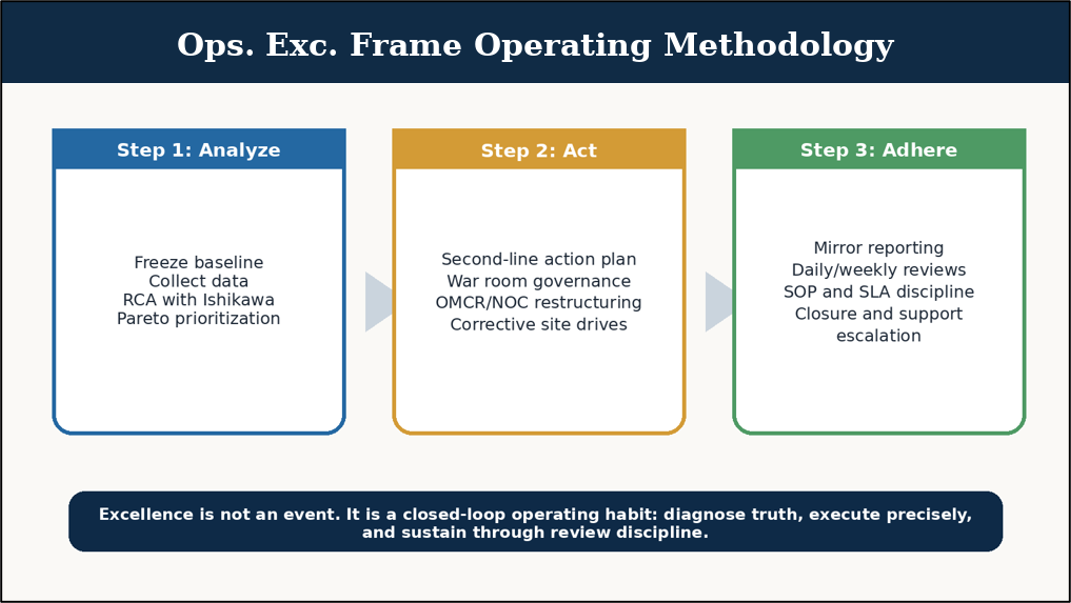
3. Step 1 - Analyze: Freeze the Baseline and Name the Root Causes
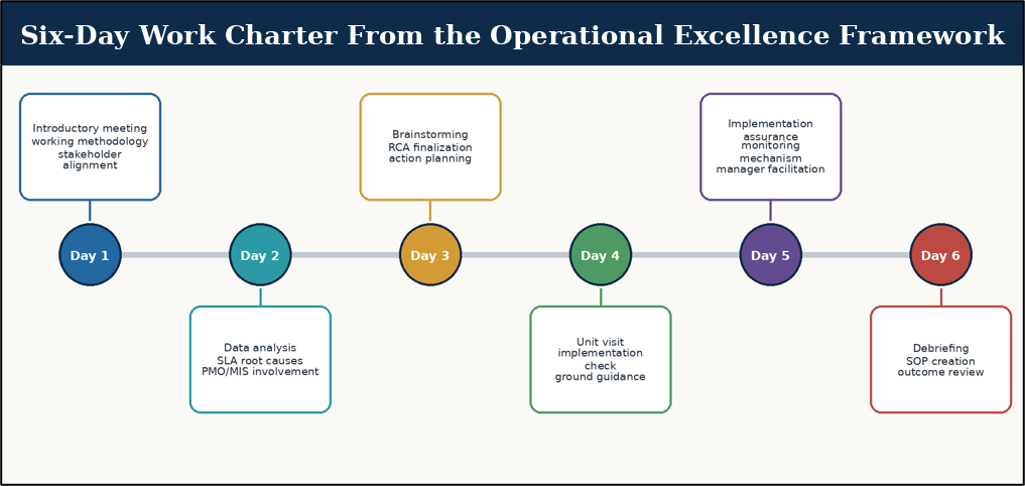
The first step in the Ops. Exc. methodology is Analyze: an in-depth root cause analysis using proven tools and practices. In the KAS case, this meant freezing the project baseline, collecting data from multiple sources, segregating issues, mapping the SLA penalty scope and using Fishbone plus Pareto tools to understand where the highest loss was coming from.
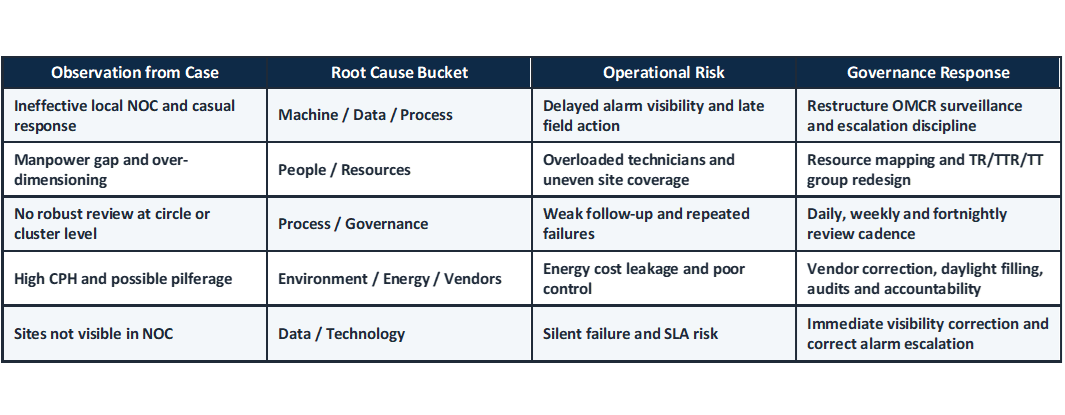
The case document listed eight major observations: lack of operating discipline, insufficiently assertive circle leadership, uneven responsibility assignment, ineffective local NOC, manpower gaps and over-dimensioning, lack of real-time urgency at field level, absence of an operational excellence drive in network availability and energy, and weak review mechanisms at circle or cluster level.
This is exactly where honest RCA matters. A cause field that never names a role, a process gap or a control failure does not change the operation. Root cause analysis must be allowed to identify the real operating behaviour that created the failure.
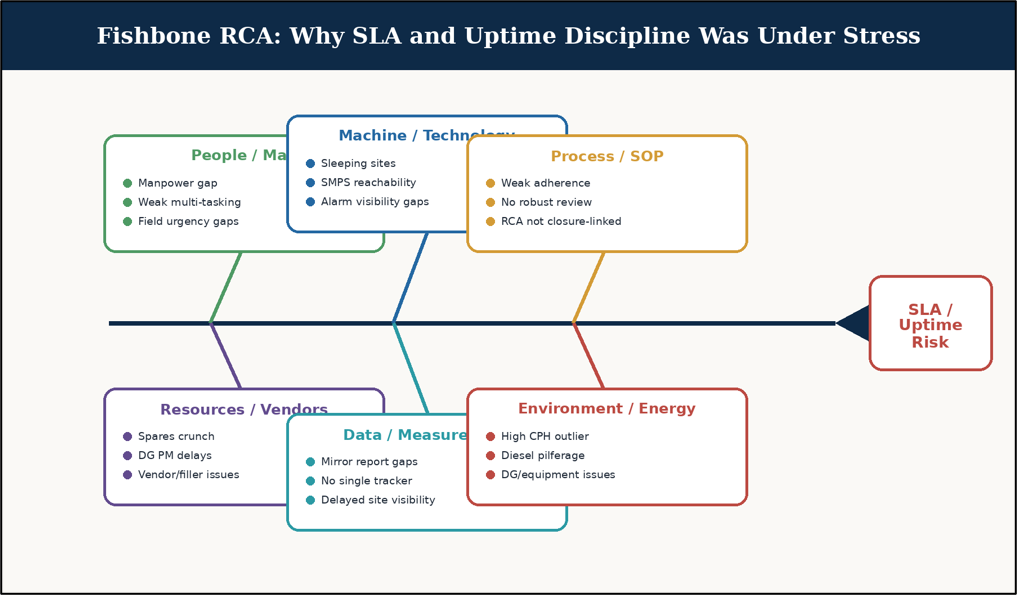
The fishbone diagram above maps the KAS case issues into the Operational Excellence categories:
- People/Man,
- Machine/Technology,
- Process/SOP,
- Resources/Vendors,
- Data/Measurement and Environment/Energy.
This converts observations into a practical RCA structure.
RCA Table: From Observation to Root Cause Bucket
4. Pareto Tool: Focus on the Few Causes Creating the Largest Loss
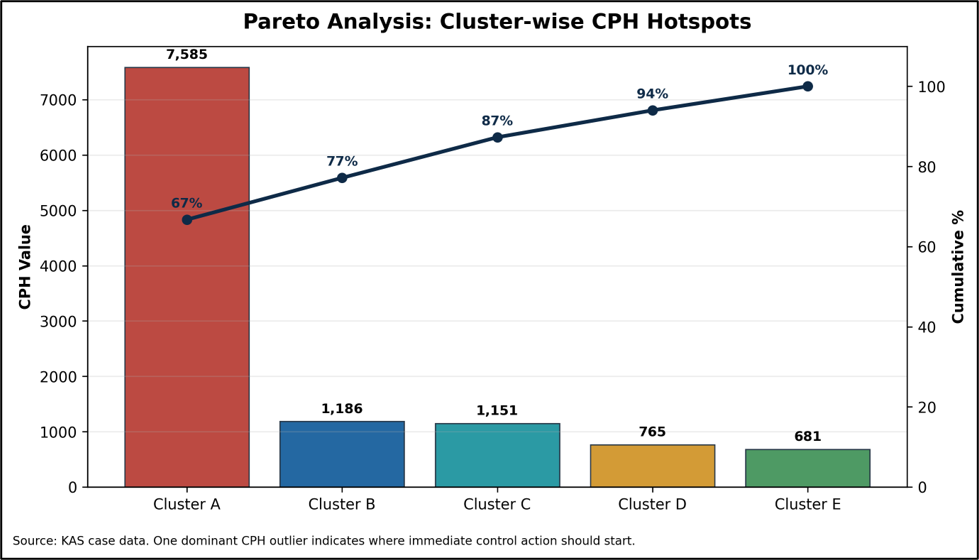
The Ops. Exc. framework emphasizes Pareto analysis because effort should not be spread evenly across problems that are not equally expensive. The KAS case provides a clear example through cluster-wise CPH data. One cluster reported a CPH value of 7,585, while the other clusters were far lower at 1,186, 1,151, 765 and 681.
This pattern immediately tells a leader where to begin. The first cluster alone represents the dominant share of the CPH hotspot problem. A normal review may say 'energy cost is high', but a Pareto view says 'start here, assign owner, investigate vendor route, filling discipline, DG PM, equipment health and fuel measurement integrity'.
This is the practical power of Pareto: it converts noise into priority. Once the highest-value causes are identified, the action plan can be sharper, faster and more accountable.
5. Data Mapping: NOC Visibility as an Uptime Enabler
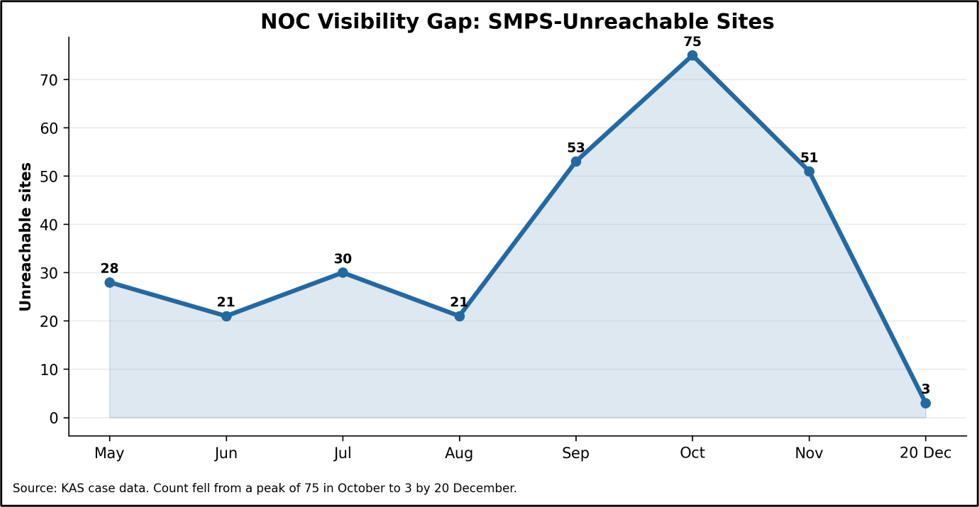
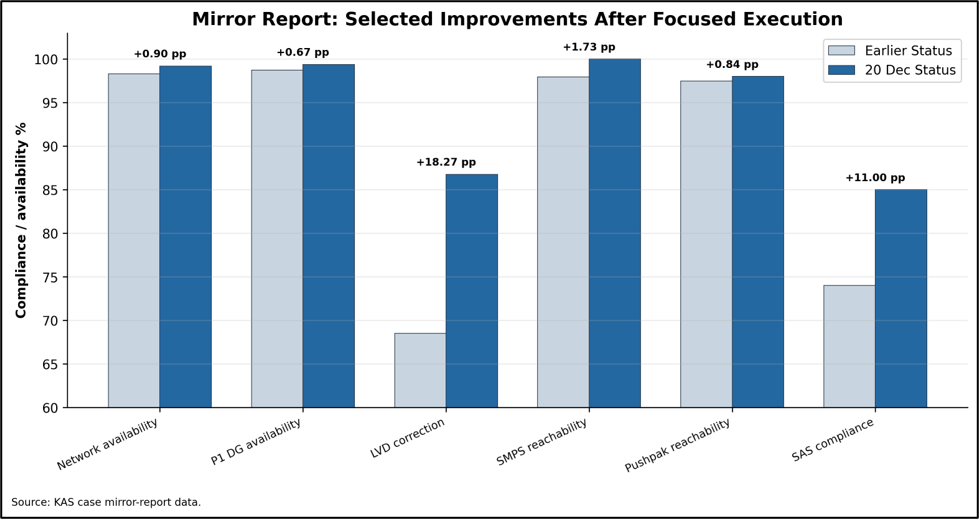
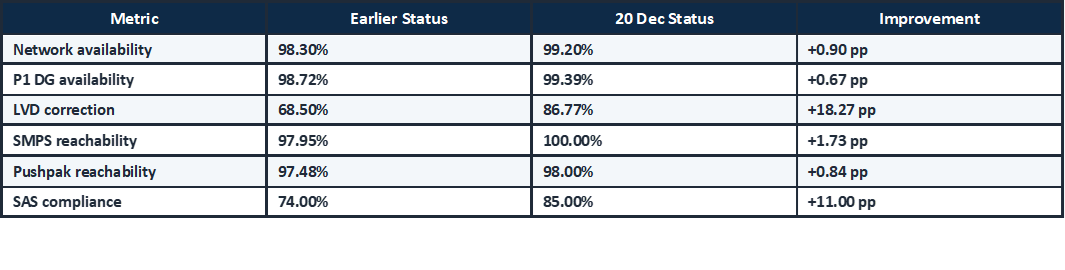
One of the strongest data points in the KAS case is the 'sites not visible in NOC' trend. The count of SMPS-unreachable sites moved from 28 in May to 21 in June, 30 in July, 21 in August, 53 in September, 75 in October, 51 in November and finally 3 by 20 December.
This is not merely a dashboard item. If a site is not visible, the NOC cannot trigger correct preventive response. The field team receives delayed or incomplete information. The operation then becomes reactive instead of preventive.
The improvement to 3 by 20 December shows the value of treating visibility as a control layer. It proves that the NOC is not just a reporting function; it is the nerve centre of uptime governance.
6. Step 2 - Act: Convert Diagnosis into Field Execution
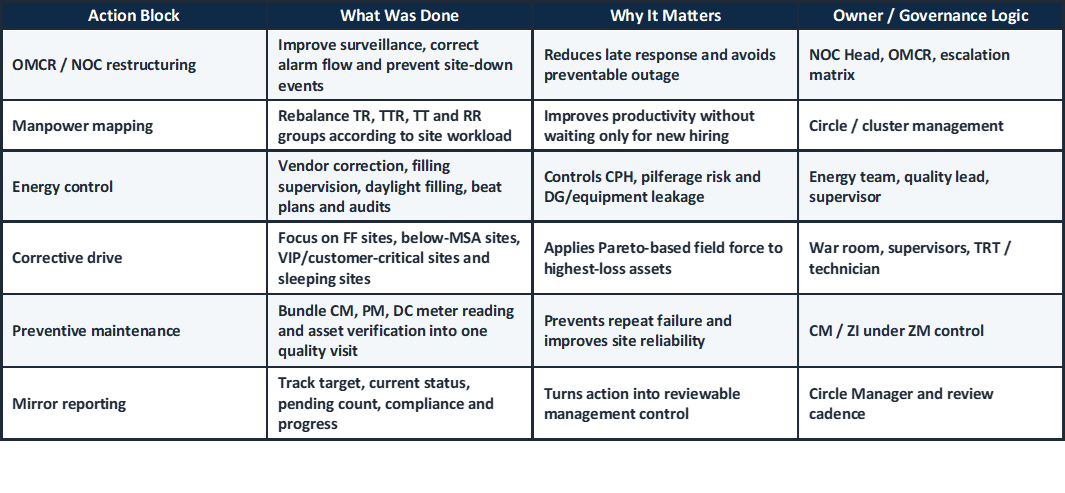
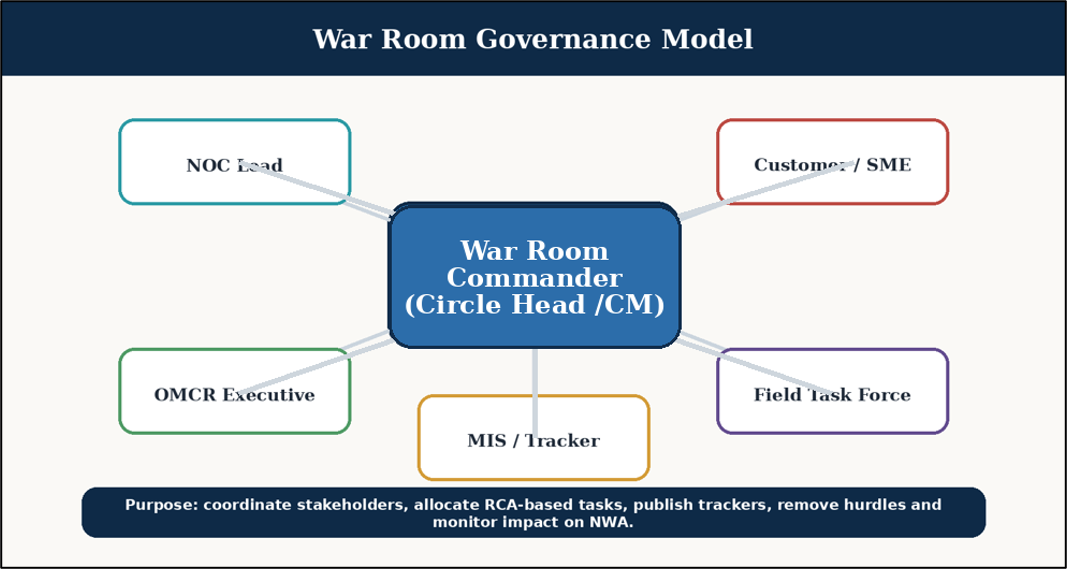
The Ops. Exc. framework defines Act as the implementation of corrective measures to address root cause and impact. In the KAS case, the action phase was practical, role-linked and time-bound. It included OMCR restructuring, manpower mapping, war-room formation, energy correction, NOC visibility restoration and site-level corrective drives.
The network availability improvement plan was divided into five steps: effective and aggressive OMCR, immediate focus on sites not visible in NOC, corrective drive on selective sites, structured site visits for preventive maintenance, and a special drive on mirror reporting.
The important point is that the action was not generic. Sites were prioritized based on Pareto findings: frequently failing sites, sites below MSA, sleeping sites not visible on local terminals, high-penalty SAG/AG1/HUB sites and customer-critical VIP sites. This is how analysis becomes execution.
Operational Excellence Action Plan Table
7. Step 3 - Adhere: Sustain the Gain Through Governance Cadence
Many improvement programs fail because they stop after action. The PPT wisely adds the third stage: Adhere. This is the point where improvement becomes management habit. In the KAS case, adherence was built through the mirror report and a defined governance cadence.
The mirror report was not valuable because it was a table. It was valuable because it created a single truth for action status, target, scope, completed count, pending count, compliance and progress. It forced leadership to ask: what has improved, what is still pending, who owns the variance and what support is required?
The review structure was also clear: daily conference call on the mirror report by the Circle Manager with ZIs, weekly review with ZIs by the Circle Manager and Quality Lead, weekly CTO review involving CM, QL and ZIs, and fortnightly governance meeting with ZIs and supervisors. This is Adhere in practice.
8. Resource and Support Required: Do Not Push the Field Without Removing Blockers
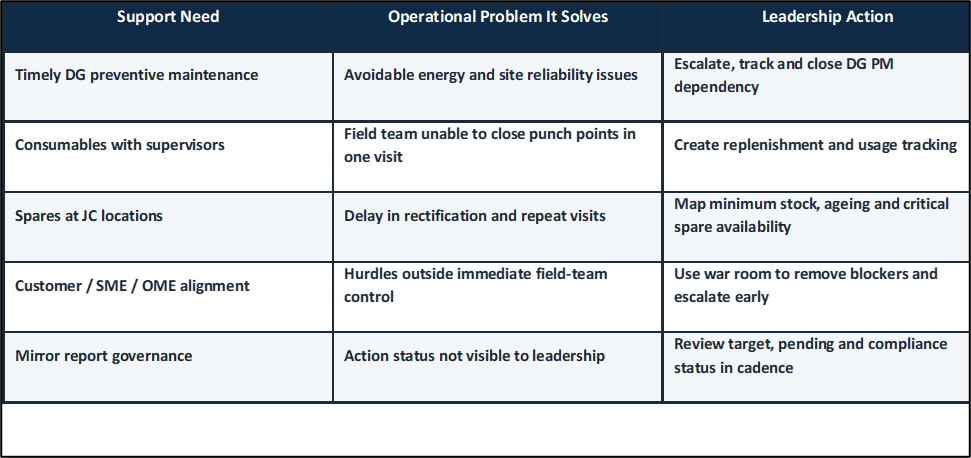
The Ops. Exc. framework closes with resource and support requirements. This is a critical leadership point. Adherence does not mean putting endless pressure on the field. It also means removing the blockers that prevent the field from delivering.
The KAS case highlighted practical support needs: timely DG preventive maintenance, especially on M&M equipment; consumables availability with supervisors; spares availability at JC locations; and joint resolution support for DG NRI and owner issues.
A governance-led leader does not stop at assigning responsibility. He also makes sure that the person receiving responsibility has the authority, resources, support and escalation access needed to close the issue.
9. Transferable Playbook: Analyze - Act - Adhere
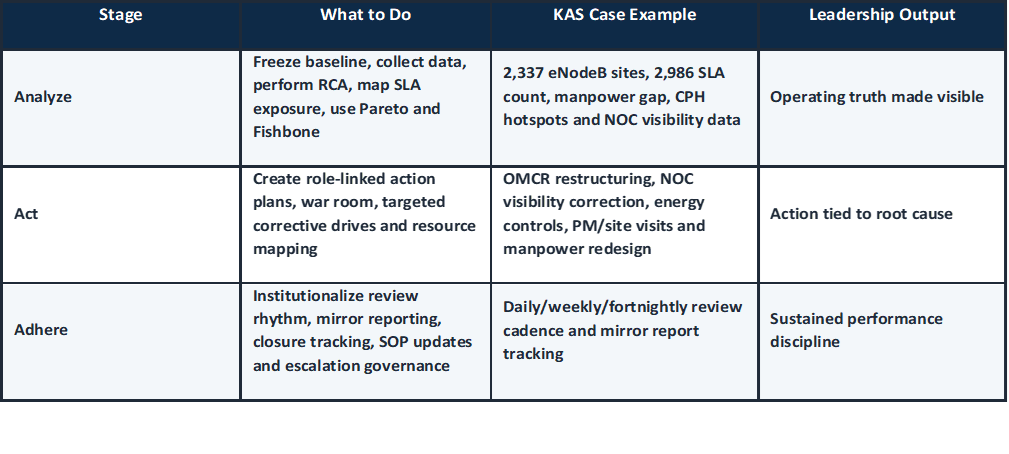
This framework is transferable to telecom circles, tower operations, DMS/IDP operations, NOC/PMO environments, distributed service delivery and other infrastructure-led operating models.
The leadership lesson is simple: excellence is not a presentation, not a dashboard and not a one-month drive. Excellence is the habit of facing facts, acting precisely and sustaining discipline through governance.
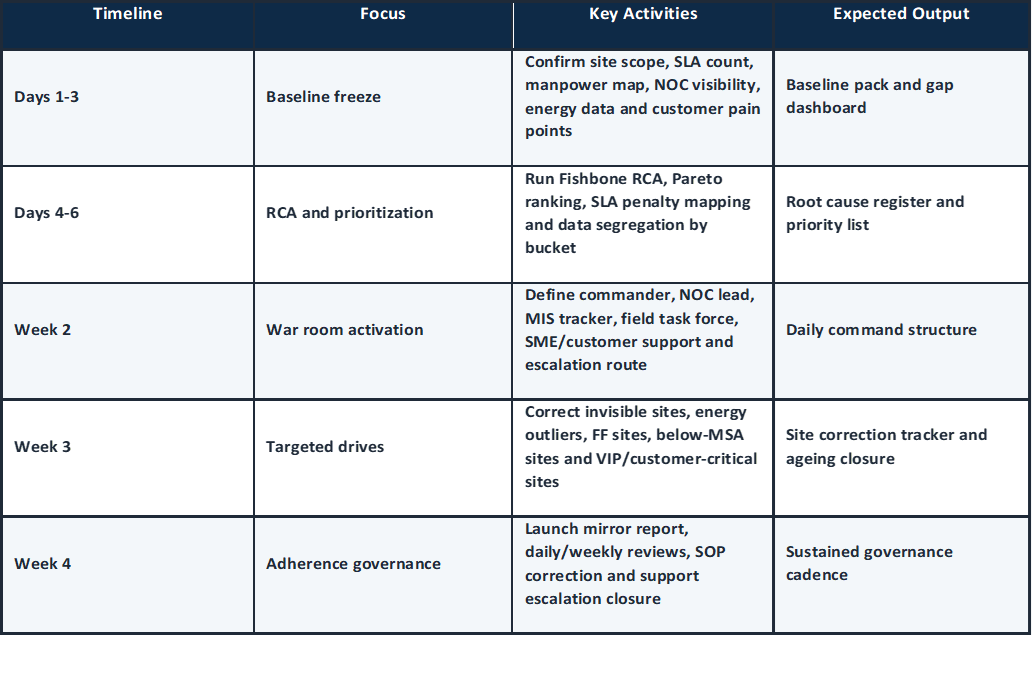
10. 30-Day Practical Implementation Plan for a Similar Circle
Conclusion
The KAS case study proves that operational excellence is a disciplined management practice. It begins with honest diagnosis, moves through focused action and survives only when adherence is governed.
A large operating circle with thousands of sites cannot be improved by general instructions. It needs a structured methodology: freeze the baseline, identify high-loss causes, deploy field action through second-line managers, correct NOC visibility, control energy leakage, improve preventive maintenance and institutionalize mirror-report governance.
For leaders managing telecom, tower, utility or distributed service operations, the message is clear: do not confuse activity with excellence. Operational excellence is achieved when the organization becomes operationally intelligent.
About Author:

Salman Ahmad Siddiqui
Independent Director inoperant | Operational Excellence & Board Intelligence Practitioner
Founder & CEO SyhaConnect Innovations
Contacts: +91 9625899500 | +91 9582649500
Email: hello@salmansiddiqui.in | connect@syhaconnect.in | syhaconnect@gmail.com
LinkedIn: https://www.linkedin.com/in/salmansiddiqui38442236/Web Site: www.salmansiddiqui.in | www.syhaconnect.in
Author Positioning
Prepared in my voice and professional positioning as Salman Ahmad Siddiqui — a governance-led operational transformation leader focused on SLA discipline, NOC/PMO execution, OPEX control, field-force productivity, second-line leadership and my signature Analyze – Act – Adhere methodology.
My professional journey as an Air Force veteran, Founder & CEO of SyhaConnect Innovations, Operational Excellence Strategist, ILA-certified corporate trainer and enterprise coach has been shaped by more than 30 years of experience across telecom infrastructure, DMS/IDP operations, fibre, tower operations, NOC/PMO leadership, multi-site execution and governance-led business transformation.